Choosing the Best Mouse DPI for Office Work
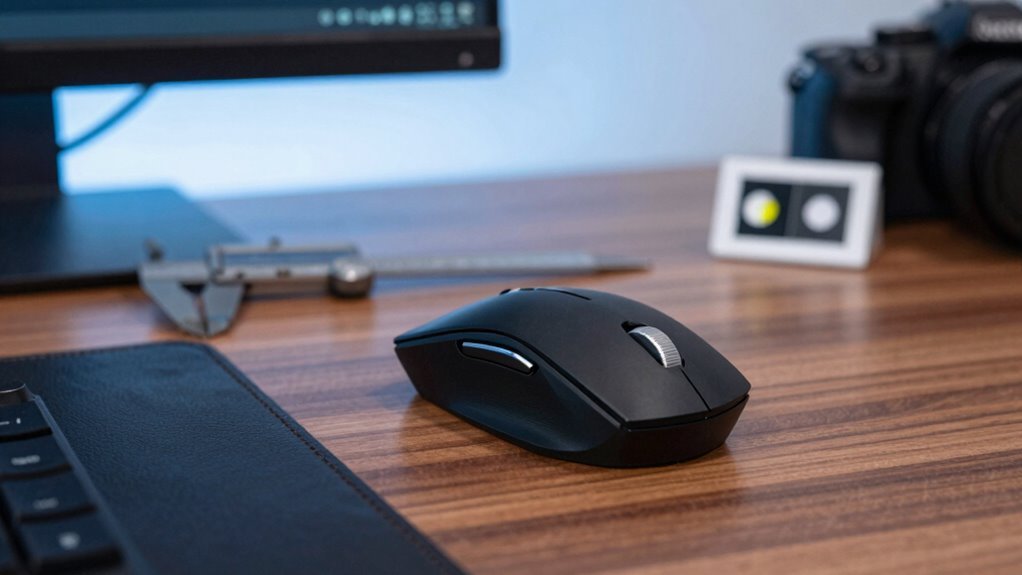
You’re gliding through emails and spreadsheets like a pro when your DPI’s just right—aim for 800 to 1600 for smooth, stress-free control. Too low and you’re swiping arm-width across the desk; too high and your cursor zips past buttons like it’s late for a meeting. Match your grip and screen size, tweak on the fly with a DPI button, and suddenly every click feels *just right*—like tech goldilocks mode. And hey, there’s a little more magic where that came from…
Understanding DPI: What It Means for Your Workflow
Ever wonder why your cursor zips across the screen with just a flick of the wrist?
That’s DPI—Dots Per Inch—at work.
When you nudge your mouse one inch, 1600 DPI shoots your cursor 1600 pixels, like a turbo boost for movement.
Higher DPI means more sensitivity, so tiny hand shifts send the cursor flying.
Lower DPI? You get precision, great for careful clicks.
Don’t get hung up on CPI vs. DPI—makers use them the same way, even if nerds insist they’re different.
Your mouse sensor counts those dots or counts per inch, sending signals faster than you notice.
On a sharp 4K screen, higher DPI keeps things smooth.
Adjust it in software or, better yet, with a quick button press.
It’s like shifting gears—speed when you want it, control when you need it.
For everyday tasks like word processing or web browsing, 1000–1600 DPI generally strikes the right balance between responsiveness and control.
Boom: you’re in command.
Recommended DPI Ranges for Everyday Office Tasks
While you’re not aiming for headshots in a fast-paced shooter, your office mouse still needs the right touch to keep things smooth and sane. For everyday tasks like emails, browsing, and spreadsheets, stick with 800–1200 DPI—it’s the sweet spot that keeps your cursor zipping just right without turning your arm into a sprinter’s. If you’ve got a bigger or sharper screen, 1200–1600 DPI helps you cover more ground with less arm flailing. Need pixel-perfect clicks for charts or tiny cells? Dial down to 400–800 DPI when precision rules the day. This range aligns well with the ideal productivity range of 800–1600 DPI commonly recommended for office environments.
| DPI Range | Best For |
|---|---|
| 800–1200 | Daily tasks, balanced control |
| 1200–1600 | Larger screens, faster navigation |
| 400–800 | Fine detail work, exact clicks |
Adjusting DPI for Different Work Applications

How does your mouse keep up when you jump from crunching numbers to crafting a presentation?
You need speed for scrolling across spreadsheets, but precision when selecting a single cell—switching to 1800+ DPI gets you there fast, while dropping to 800 DPI locks in accuracy.
Luckily, your mouse’s DPI button lets you toggle on the fly, so you’re not stuck repositioning the cursor constantly.
With Logitech, Razer, or Corsair mice, you can set custom levels using G Hub, Synapse, or iCue—just assign a button, and boom, you’ve got instant control.
Need fine detail in Illustrator? Dial it down.
Exploring big tables? Crank it up.
Test different levels over a few days, and you’ll find your sweet spot.
Plus, LED cues keep you in the loop without the guesswork.
It’s like giving your mouse superpowers—one click at a time.
A dedicated DPI-switch button ensures seamless transitions between tasks, enhancing efficiency across workflows.
How Screen Size and Resolution Impact DPI Settings
You’ve got your DPI switching down pat between apps, but what happens when your screen gets a serious upgrade?
Boom—4K resolution, more pixels than your mouse knows what to do with.
Suddenly, your cursor feels like it’s trudging through syrup.
That’s because higher resolutions pack in more pixels, so the same DPI means slower, choppier movement.
You’ll need a higher DPI to glide smoothly across that expanded digital real estate.
Think of it like upgrading from a scooter to a sports car—your screen’s faster, so your mouse should keep up.
Match your mouse DPI to your screen’s pixel density for that sweet 1:1 movement, especially on a 26-inch 1920×1200 or larger.
Skip the math if you want, but don’t skip the tweak—your wrist will thank you when you’re not swiping halfway across the desk just to click “send.”
Matching DPI to Your Mouse Grip and Movement Style

Ever wonder why your cursor feels like it’s fighting you—or worse, sends you into a death spiral of overshooting buttons and frantic backtracking?
That struggle often comes down to grip and movement style.
If you palm your mouse, go low to mid DPI (800–1400) for smooth arm glides.
Claw grippers? Try 1000–1800—fast flicks, less wrist drama.
Fingertip users, you’re all about speed, so 1400–2400 DPI keeps tiny finger jabs efficient.
Match your DPI to how you move, not just your screen size.
- Your mouse should feel like an extension of your hand, not a rebellious robot
- Wrist strain sneaks in when DPI fights your natural motion
- Tiny adjustments add up—big fatigue from small mistakes
- Precision shouldn’t mean holding your breath and praying
- A good DPI choice makes work smoother, faster, and way more fun
Optimizing Multi-Monitor and High-Resolution Setups
Now that you’ve got your grip dialed in and your mouse moving like it’s part of your hand—not a stubborn garage door opener—it’s time to talk real estate: your screen space.
With multiple monitors or a shiny 4K display, low DPI makes your cursor crawl like it’s stuck in digital molasses.
You’ll need 1000–1600 DPI to glide smoothly across screens without wrist strain.
If you’re leaping from a 1080p to a 4K monitor, start at 1600 DPI—your cursor’s gotta sprint four times farther!
Tools like LittleBigMouse or KDE Plasma’s scaling help tame mismatches between screens.
Test by sweeping edge-to-edge; if you’re lifting your mouse, crank up the DPI.
Click tiny icons with ease and keep speed in check using 100–200 DPI tweaks.
Pair high DPI with 1000Hz polling for buttery, tear-free motion.
Your multi-monitor kingdom deserves a cursor that keeps up—no more chasing pixels like they’re escaping!
Fine-Tuning DPI for Precision and Comfort Over Time

While your mouse mightn’t need a PhD in precision, treating it like a finely tuned instrument pays off when you’re dodging spreadsheet cells at lightning speed or lining up bullet points like a digital architect.
Start around 800–1200 DPI, then tweak in small steps—your wrist will thank you.
Match lower DPI to pixel-perfect tasks like photo editing, and bump it up slightly for sweeping moves across big screens.
Use your OS settings and mouse software together, like peanut butter and jelly, for smooth control.
Over time, save profiles for different tasks so switching feels effortless.
- Your mouse remembers what your brain forgets
- Less strain means more groove, not doom
- Tiny tweaks today prevent big pain tomorrow
- Smooth clicks beat frantic flicks any day
- You’re not just working—you’re gliding
Frequently Asked Questions
Can Changing DPI Affect Gaming Performance?
Yeah, changing DPI totally affects your gaming performance.
Crank it up, and your cursor flies across the screen with barely a flick—perfect for fast twitch games.
Drop it low, and you’re painting pixels with precision, ideal for sniping or careful aiming.
You’re in control of speed versus accuracy, so tweak it, test it, and own your style.
Pro gamers don’t guess—they fine-tune.
Your mouse, your rules!
Is There a Standard DPI for Wireless Mice?
No, there’s no one-size-fits-all DPI for wireless mice—they’re all over the map.
You’ll find most start at 800 or 1,600 DPI out of the box, but they let you tweak it to fit your groove.
Think of it like shoe sizes—what feels perfect for your coworker might feel clunky for you.
Play around, trust your gut, and find your sweet spot.
It’s your mouse, your rules!
Do All Mice Allow DPI Customization?
No, not all mice let you tweak DPI—only the fancier ones do.
If you’ve got a basic office mouse, you’re stuck adjusting sensitivity through your computer’s settings, which isn’t quite the same.
Gaming or premium mice? They’ve got buttons and software that let you switch DPI on the fly, like shifting gears in a sports car—zoom!
But your average plug-and-play mouse? Nah, it’s more like a bike with one speed—simple, but not very flexible.
Can High DPI Cause Cursor Jitter?
Yeah, high DPI can totally cause cursor jitter—think of it like turning up a microscope and seeing every tiny shake or sensor hiccup.
Your hand trembles a bit? Now it’s a rollercoaster.
Surface flaws, sensor noise, or wonky drivers get amplified too.
Drop the DPI down a notch, clean your mouse, and use a decent pad.
Smooth moves guaranteed!
Does DPI Impact Battery Life in Wireless Mice?
Yeah, high DPI does nibble a bit more battery, but it’s not the big bad wolf—your mouse won’t gasp for power after one scroll.
Higher DPI means the sensor works harder, yes, but it’s like choosing between sprinting and jogging: noticeable over time, but not life-changing.
You’ll save way more juice by dimming flashy lights or switching to Bluetooth.
Conclusion
You’ve got this! Now that you’re tuned in to the sweet spot for your office mouse DPI, every scroll and click will feel like second nature. Whether you’re crunching numbers or dashing off emails, the right setting keeps you gliding smoothly, not crawling like a snail. Don’t sweat perfection—tweak as you go, stay comfy, and remember: it’s not rocket science, just finding your groove. Happy mousing!