High-Tech Meets High-Style: Modern Office Design
You walk in, and the office greets you like a VIP—lights adjust, your go-to seat’s free, and the air smells like a spa thanks to living green walls. Mobile pods, smart sensors, and sunlit lounges make work feel effortless. You’ll love how tech handles the boring stuff while style wows your guests. Plus, every detail—from reclaimed wood to AI calendars—works quietly to keep you comfy, focused, and smiling. There’s a whole lot more where that came from.
Designing for Collaboration in Hybrid Work Environments

Ever wonder how your office can feel alive even when half the desks are empty?
That’s because you’re not filling space—you’re fueling connection.
Swap rows of lonely desks for vibrant zones: cozy focus booths, energetic team hubs, and chill lounges where ideas spark like coffee breaks.
You’ve got mobile furniture and smart partitions that transform solo zones into collaboration zones in minutes—talk about office yoga!
With only a few people in daily, sight-lines and clear wayfinding help everyone find the action fast, no treasure map needed.
Book rooms, not seats, and let your team grab spaces like concert tickets—real-time tools keep chaos out and teamwork in.
And hey, if your meeting room’s booked, blame the calendar, not your coworker.
Suddenly, your office isn’t just open—it’s alive, flexible, and actually fun to work in.
As hybrid models solidify, 52% hybrid reflects the new normal—offices now designed for connection, not just attendance.
Smart Technology That Enhances Everyday Workflows
You’ve got your collaboration zones humming and your team hopping between focus booths and lounges like office ninjas—now let’s give those spaces a brain.
Smart sensors track room use in real time, so you’ll never waste money on empty desks.
AI adjusts lighting and temperature before you even think to complain.
You’re saving up to 60% on energy while your team stays sharp—talk about a win-win.
Platforms stitch together data like a digital quilt, showing exactly how spaces are used.
Smart hubs help remote teams plug in seamlessly.
Your calendar? Auto-synced by AI that even suggests better meeting times (and yes, it cancels ghost meetings).
With 65% of companies using tools like ChatGPT, you’re not just keeping up—you’re outpacing.
And get this: these upgrades boost productivity by 15% and pay for themselves fast.
The future’s not just smart—it’s basically thinking for you.
68% of enterprises invest in smart office solutions.
Wellness-Oriented Spaces for Mind and Body

While your brain might crave a caffeine boost by 10 a.m., your body’s really asking for a workspace that cares.
You get it—staring at screens all day’s rough, but swapping fluorescent lights for sunlight and plastic chairs for ergonomic ones? That’s a mood.
Imagine stepping into a space with living green walls, soft natural light, and desks that adjust so you can stand like a superhero if you want.
Sound nice? It’s real.
Your office isn’t just smart—it’s caring.
Quiet pods let you escape for a reset, while AI tunes lighting and airflow to match your rhythm, not fight it.
Need focus? There’s a low-stimulation zone.
Need a breather? A meditation nook’s got your back.
With reclaimed wood, calming textures, and sound-absorbing panels, your workspace doesn’t just look good—it helps you feel good, think clearer, and stress less.
Wellness rooms and relaxation spaces support mental well-being, so unwinding during a busy day becomes part of a healthier, more balanced work life.
Who knew work could be this kind to you?
Sustainable Choices From Materials to Operations
How do you build a workplace that loves the planet as much as you do?
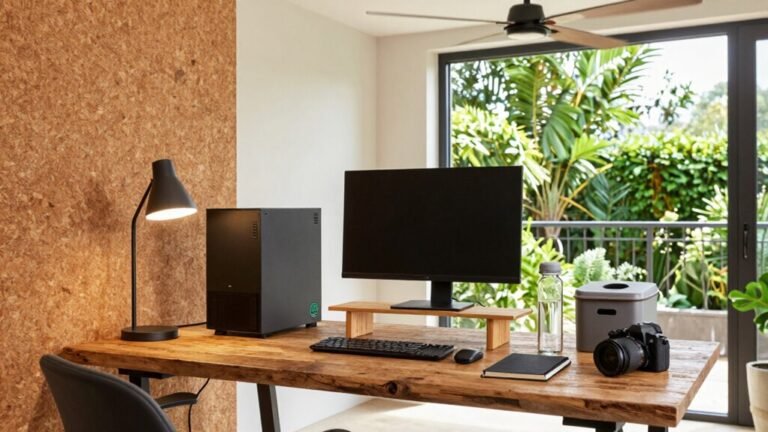
You start with bamboo floors and cork walls—tough, gorgeous, and kind to Earth.
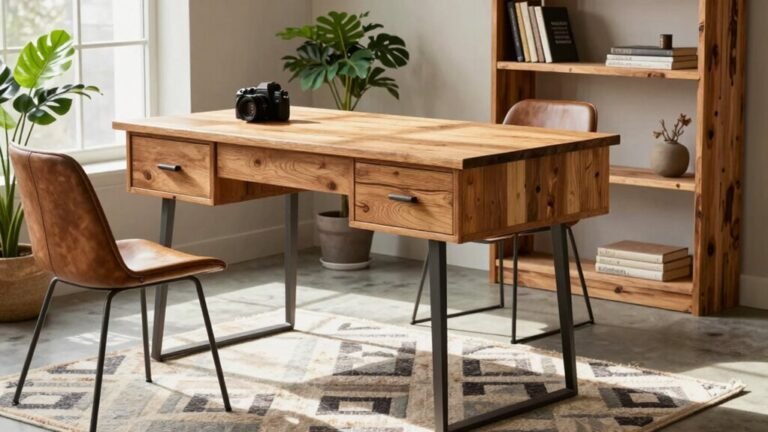
Reclaimed wood desks? Yes, please—they’ve got history and save trees.
Swap plastic chairs for recycled ones; toss in modular furniture from old metals, and boom—stylish *and* sustainable.
Use smart sensors to dim lights and adjust temps when no one’s around—because saving energy shouldn’t depend on remembering to flip a switch.
Opt for linoleum, mycelium leather, or FSC-certified wood; even your ceiling can be low-carbon mineral wool.
Recycle, refurbish, and repurpose everything—carpet tiles, steel, glass, you name it.
Ferrock concrete soaks up more CO2 than it emits—how cool is that?
With zero-waste goals and eco-smart operations, your office doesn’t just work hard—it works *right*.
Creating a Magnetic Workplace Experience

- Embrace smart tech: 72% of folks find digital tools *extremely* important—think AI that helps, not hounds.
- Offer real flexibility: 65% crave schedule freedom—let people microshift and thrive, whether at a desk or their kitchen table.
- Support mental well-being: 81% care if you’ve got their back—quiet zones and real resources beat free snacks any day.
- Design for connection: Bad collaboration kills joy—use tools that chat, check in, and keep teams in sync (without awkward icebreakers).
Make your office feel alive—not just lit.
Data-Informed Design for Smarter Space Optimization
Ever wonder why your office feels half-empty, even on busy days? You’re not alone—global office utilization hovers around 54%, and many spaces sit idle. But here’s the good news: data can turn your underused floors into smart, agile environments.
By tapping into real-time insights—from Wi-Fi tracking to desk sensors—you’ll see exactly how spaces are (or aren’t) being used. This isn’t just number-crunching; it’s your secret weapon for cutting costs and boosting efficiency.
Here’s a peek at what matters:
| Key Metric | Why It Helps You |
|---|---|
| Desk occupancy | Know how many desks you *really* need |
| Meeting room usage | Stop booking 10-seat rooms for 2 people |
| Peak times | Plan resources when your team’s busiest |
| Spatial flow | Fix traffic jams near the coffee machine |
| Vacancy trends | Spot underused zones ripe for reinvention |
Use the data, save money, and design smarter—you’ve got this!
The Aesthetic Edge: Where Function Meets Form

What if your office could feel as cozy as your living room but still nail that polished, professional vibe?
You’re not dreaming—you’re just designing smarter.
Today’s spaces blend style and substance like never before, so you stay comfy, focused, and maybe even a little happier.
Here’s how you win at the aesthetic edge:
- Mix warm textures like timber, linen, and stone with clean lines to soften the office without losing focus.
- Flood the space with natural light and add living plants—or a tiny indoor jungle—to lift moods and purify the air.
- Choose earthy colors like sage and clay that calm the mind and quietly scream, “We care about the planet.”
- Use modular furniture that moves, adapts, and wows, because who doesn’t love a sofa that moonlights as a meeting pod?
Function meets flair—and your office just got a major glow-up.
Frequently Asked Questions
How Do We Accommodate Remote Employees in Office Design Decisions?
You make remote folks feel included by designing spaces where they’re seen and heard just as clearly as if they were there.
Use high-quality cameras, mics, and screens in every room so they aren’t stuck with a sad head on a laptop.
Guarantee seamless tech, strong Wi-Fi, and quiet zones so their experience is smooth, fair, and maybe even fun—no one wants to be the pixelated voice from the void.
What Happens to Unused Office Spaces During Hybrid Shifts?
You’re turning empty desks into gold mines, not letting them gather dust like forgotten relics.
You shrink square footage, slash costs, and morph vacant zones into vibrant hubs—think fitness nooks, cozy cafes, or collaboration pits where ideas spark like popcorn.
Unused space? It’s not dead, just napping.
You wake it up smarter, leaner, and way more fun—like giving your office a glow-up Instagram wouldn’t believe.
Can Smart Tech Really Reduce Employee Stress Levels?
Yes, smart tech can really dial down your stress—if it’s done right.
You’re less frazzled when apps handle repetitive tasks, lights adjust to match your energy, and quiet pods let you recharge.
Imagine your office knowing you’re overwhelmed and quietly suggesting a break—how cool is that?
But if it feels snoopy or clunky, it backfires.
You want helpful, not creepy.
Are Biophilic Elements Cost-Effective in Large Office Layouts?
You’re not just planting greenery—you’re growing savings.
Yeah, biophilic elements are cost-effective in large offices, especially when you scale up.
Daylight cuts energy bills, plants boost focus, and fewer sick days mean more done.
Sure, big atriums cost more upfront, but spread across hundreds of workers, it’s a bargain.
Think of it as nature paying dividends—your wallet *and* your team will thank you.
How Do We Measure ROI on Wellness-Focused Design Changes?
You measure ROI on wellness-focused design by tracking real savings—like lower healthcare costs, fewer sick days, and less turnover—and add them up.
You compare what you spent on changes to those gains, using (net savings ÷ cost) × 100.
It’s like judging a smoothie’s worth: if it boosts mood, focus, and attendance, and you’re not replacing staff every month—you’re winning.
And hey, happy employees don’t just smile more, they perform.
Conclusion
You walk in, coffee in hand, and boom—your favorite playlist fires up automatically. The lights brighten just right as the window tint adjusts, all while your desk remembers your ideal height. Around you, plants purify the air, coworkers laugh in a sunlit nook, and someone’s already booked the quiet pod. It’s not magic, it’s design—and yes, it *does* make Mondays better. Who knew work could feel this alive?