The Benefits of Smart Lighting for Home Office Productivity
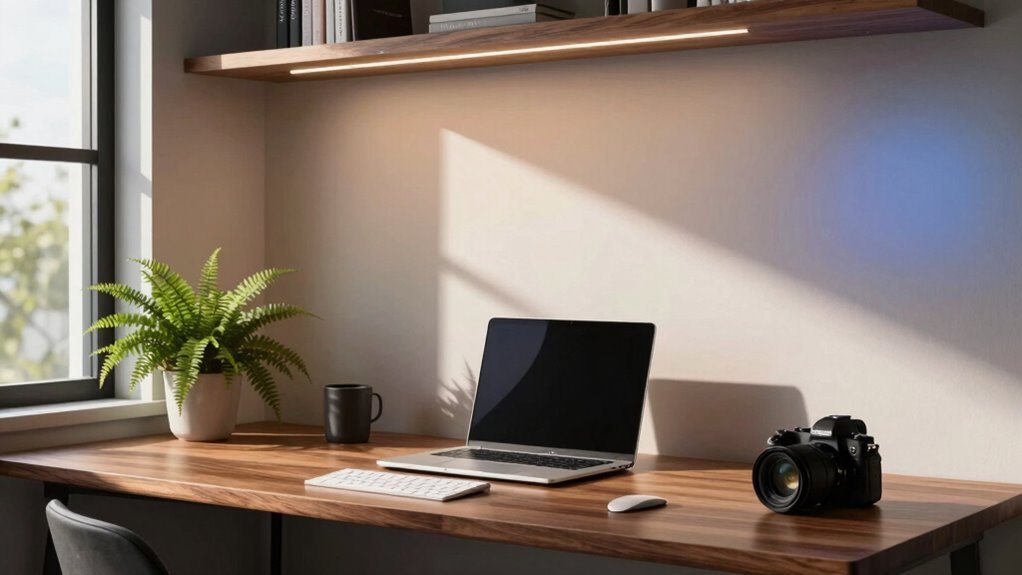
You wake up sluggish, but your smart lights greet you like a sunrise, kicking your energy into gear. They keep your eyes comfy, boost focus with bright blue-white tones, and even tell others you’re in the zone with a quick red glow. No more mood dips or glare headaches—just smooth, vibrant days that sync with your body’s rhythm. And hey, your wallet will thank you too—stick around to see how.
Aligning Light With Your Body’s Natural Rhythms
Ever wonder why you feel sharper on sunny mornings than under the fluorescent buzz of a dim office?
That’s your circadian rhythm kicking in—sunlight tells your body, “Hey, time to wake up!”
Bright, cool-white light (think 5000–6500 K) in the first few hours after waking resets your internal clock, boosting alertness and focus.
You’re not just faking energy—you’re synced with nature’s rhythm.
Smart lighting brings that sunshine indoors, ramping up brightness each morning so you start strong, even on gloomy days.
No more slouching toward the coffee pot like a zombie.
Plus, studies show this early light leads to better sleep and fewer gloomy moods.
Whether your home office gets real sunlight or not, dynamic LEDs can mimic the morning sky, giving your body the cues it craves.
This alignment with natural light patterns supports circadian rhythm regulation.
Enhancing Visual Comfort for Prolonged Focus
You’ve got your circadian rhythm humming along nicely with bright morning light, waking up your body like a sunny alarm clock—now let’s make sure your eyes aren’t paying the price by mid-afternoon.
Daylight feels better on your eyes than plain electric light, especially in the afternoon, so grab all the natural light you can.
Even without a window view, sunlight still wins in comfort.
Pair it with smart ceiling lights that dim or brighten automatically, and you’re golden.
Blue-white LEDs can help, making artificial light feel fresher and more natural.
Glare’s the real office buzzkill, though—watch those shiny screens and harsh bulbs.
Good lighting control keeps discomfort at bay and focus high.
Studies show mixing daylight with smart lighting boosts comfort most.
Dynamic lighting has been shown to increase afternoon alertness, supporting sustained focus during work hours, particularly under dynamic LED lighting.
Skip the glare, embrace the glow, and let your eyes work happy, not hard.
Boosting Alertness and Cognitive Performance

What if you could hack your brain’s focus with just a flick of the light switch—no coffee chug required?
You *can*—with smart lighting tuned to boost your alertness and brainpower.
Crank up the brightness to 1,000 lux or more, and you’ll feel more awake, react faster, and slash errors on tough tasks.
Blue-enriched light? It’s like nature’s espresso shot: it wakes up your hypothalamus, quiets melatonin, and sharpens memory and attention.
Use it in the morning or midday to power through emails or crunch numbers.
Schedule bright, cool-toned light at the start of work to jumpstart focus, or zap the post-lunch slump with a quick light boost.
Time it right, and you’ll stay sharp without the jitters—because who knew your ceiling could be your co-pilot in crushing the workday?
Recent research shows that higher light levels enhance cognitive performance, with posterior hypothalamus activity increasing under brighter illumination.
Reducing Stress and Supporting Emotional Well-being
Bright light wakes you up, sure—but it’s not just about staying sharp. It’s also about feeling good.
When your smart lights sync with sunrise and sunset, they keep your body’s clock happy, so stress doesn’t sneak up on you like a surprise Zoom call.
Morning’s cool, bright tones boost alertness naturally, while evenings ease into warm, cozy glows that let melatonin do its sleepy magic.
No more staring at the ceiling at 2 a.m. wondering why you’re wide awake. Gentle dawn and dusk simulations? They’re like a visual hug, calming your nerves as you start or end work.
You can dial down glare and flicker, too—because nobody likes a headache party. Pick a mood with a tap: calm, energized, or just “please-leave-me-alone.”
With lighting that adapts to you, not the other way around, you’ll feel more in control, less frazzled, and oddly, even happy to be at your desk.
Minimizing Disruptions With Smart Focus Signals
Flashing a red light doesn’t just belong in police cars or old detective movies—it’s your new secret weapon for unbroken focus.
When you flip on that bold red signal with your smart light—like a Luxafor flag—you’re telling everyone, “Do not disturb, I’m in the zone!”
No awkward conversations, no repeated interruptions.
You set the rules, and the light enforces them.
With manual buttons or automatic sync to your calendar and timers, your light switches modes instantly—just like flipping from “chill mode” to “mission mode.”
Bright, vivid LEDs stay visible even in sunny rooms, so your signal never gets lost.
It’s not rude—it’s genius.
You protect your deep work, reduce mental clutter, and keep your groove going.
Plus, knowing your focus is visually guarded makes starting tough tasks way less stressful.
You’re not just working harder—you’re working smarter, one clear signal at a time.
Saving Energy and Lowering Operational Costs
Cutting your energy bills just got smarter—and more colorful—than ever. You’re not just saving watts; you’re stacking up cash with every dimmed bulb and auto-shutoff. Smart lighting adapts to your habits, the daylight, and even your empty room, so you never pay for light you don’t use.
| Feature | Savings Impact |
|---|---|
| LED + Controls | Uses 75% less energy than old bulbs |
| Occupancy Sensors | Cuts lighting waste by up to 50% |
| Daylight Harvesting | Lowers power use on sunny days, no effort needed |
You’ll laugh all the way to the bank when your lights turn off themselves—because, let’s be honest, we’ve all forgotten to flip the switch. With smarter tech running the show, you save energy effortlessly, shrink monthly bills, and keep your home office running lean and green. Who knew being lazy could feel so efficient?
Designing for Personalization and Seamless Integration

- Your lights adjust to your rhythm, helping you feel alert when you work and calm when you rest
- One tap (or voice command!) sets the perfect scene for calls, creativity, or concentration
- No more squinting or fumbling—your space feels just right every time you sit down
- Everything just workstogether, like your lights dimming when your meeting starts
Personalization isn’t just nice—it’s *necessary* for a workspace that truly gets you.
Frequently Asked Questions
Can Smart Lighting Work Without an Internet Connection?
Yes, you can totally use smart lighting without the internet!
Your bulbs chat through local networks like Zigbee or Z-Wave, so you’re still in control.
Set schedules, dim the lights, or turn them on with motion sensors—all offline.
Use your hub, physical switches, or Bluetooth straight from your phone.
No web? No problem.
You’ll keep the mood perfect and stay productive, even if your Wi-Fi throws a tiny tantrum.
Sweet, right?
Are Smart Bulbs Compatible With Existing Dimmer Switches?
Nope, smart bulbs and old dimmer switches are like oil and water—you just don’t mix well.
You’ll likely get flickering, weird dimming, or total meltdowns.
Those sneaky dimmers chop up power, leaving your smart bulb confused and sputtering.
For smooth sailing, ditch the dimmer or swap it for a smart switch.
Your bulb will stay happy, bright, and ready to dance to your voice commands—no more throwing electronic tantrums!
How Long Do Smart LED Bulbs Typically Last?
Smart LED bulbs typically last 15,000 to 50,000 hours, so you won’t be changing them anytime soon.
If you use them 3–8 hours a day, they’ll easily go 10–20 years—way longer than old-school bulbs.
They’re built to stay bright, too, keeping up to 80% light output over time.
Just don’t cook them in a closed fixture, unless you want your bulb auditioning for a sauna role!
Do Smart Lighting Systems Require a Hub to Function?
No, smart lights don’t always need a hub—you’re clear to fly solo!
Think of Wi-Fi or Bluetooth bulbs like free-spirited songbirds; they chirp straight to your phone or router, no middleman.
Screw them in, tap your app, and boom: color shifts, dimming, voice tricks.
Hubs? They’re like friendly conductors, great for bigger setups, but for a few lights, you’re golden without one—simple, snappy, and hub-free fun.
Can Multiple Users Control the Same Smart Lighting System?
Yes, you can absolutely share control—think of it like a group chat for your lights!
You, your partner, even your teen with a voice command habit can all manage the system.
Apps let everyone log in, voice assistants recognize different voices, and wall panels work for no-login tinkering.
Platforms handle who wins if two people tap at once (spoiler: it’s usually the fastest finger).
No lighting tantrums, just smooth, synced brightness!
Conclusion
You’re not just flipping a switch—you’re conducting your own daylight symphony. Smart lighting dances with your rhythm, sharpens your focus, and hugs your mood like your favorite playlist. It cuts stress, saves cash, and winks at you with energy efficiency. Turn it on, tune in, and let your home office glow like it’s got a PhD in productivity. Sweet, huh?