Setting Up Speakers in a Small Home Office
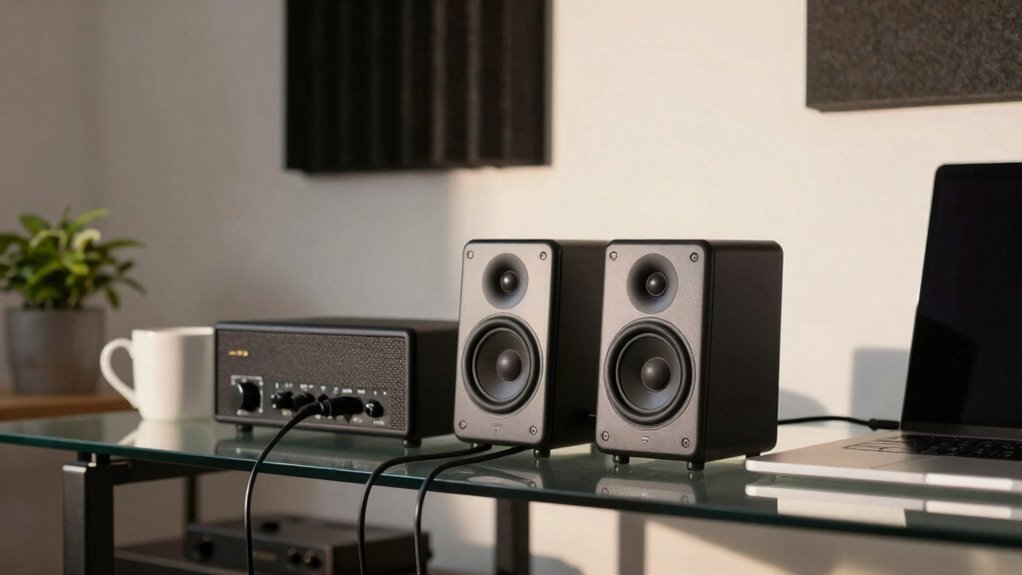
Set up your speakers in a triangle with your head and each speaker 6 to 8 feet apart, tweeters at ear level, and toes pointed slightly inward. Keep them 8–10 inches from the wall to tighten the bass, and use stands with isolation pads to cut desk vibrations. Add foam at reflection points and toss bass traps in the corners—your ears will thank you. Calibrate with your system’s mic, let the speakers break in for a few days, and boom: music feels alive. Oh, and your cat might start headbanging—just saying. There’s a little more magic where that came from.
Optimize Speaker Placement for Stereo Imaging
Ready to make your music come alive? Position your speakers to form an equilateral triangle with your head—each side 1800mm to 2400mm—so sound hits both ears at the same time, no lag, no drama. You’re the apex, baby!
Keep speaker distance equal to how far you sit from each—no favoritism allowed. Aim for 7 to 9 feet apart; it’s sweet spot heaven.
Angle them slightly inward (we call it toe-in) to boost clarity and widen that soundstage like a sonic smile. But don’t go overboard—start parallel, then tweak.
And hey, symmetry isn’t just for yoga—match distances to side walls, same materials, same vibe. Nothing kills imaging faster than one speaker feeling lonely.
Oh, and center them on the longest wall like they’re starring in a movie—because now, your playlist *is*.
Ensure identical front-wall distance for both speakers to maintain balanced bass response.
Manage Distance to Walls and Boundary Effects
Ever wonder why your bass sounds more like a boombox in a closet than a concert hall? That’s boundary loading in action—your speakers’ low end gets a boost when they’re too close to the wall, making some bass notes boom while others fade.
Get them about 8–10 inches out, especially if they’re ported, and you’ll tame that muddy thump.
It’s not just about volume—reflections cause peaks and dips in sound (that’s SBIR, or speaker boundary interference), messing with clarity.
Keep speakers at least a couple of feet from walls when you can, or try the 1/5 room length rule for smarter placement.
Early reflections from side walls smear details, so a little distance or some absorbent material helps.
You don’t need a lab—just tweak, listen, and enjoy the sweet spot magic. Bass frequencies are amplified when the speaker is close to the rear wall due to back-reflections reinforcing low frequencies.
Ensure Proper Speaker Height and Toe-In

When you’re chasing that sweet, lifelike sound, getting your speakers aimed just right makes all the difference—like tuning a radio from fuzzy static into crystal-clear FM.
Set your tweeters at ear height when you’re seated—it’s the sweet spot for clear highs and accurate imaging.
If they’re too high or low, your music might sound bright and shouty or dull and muddy.
Use stands or angled mounts to get them level with your ears, within a couple of inches.
For shelf or wall setups, a slight tilt helps aim the sound right at you.
Too much tilt? That’ll mess with clarity, so keep it minimal.
Toe your speakers in about 15°–22.5°—pointed just inside your head—for a solid center image.
Adjust in small steps while playing tunes you know well.
Match both speakers’ height and angle exactly; otherwise, the soundstage wobbles like a shaky selfie.
Symmetry is key—your ears will thank you.
Position the main listening position so it’s centered on the short wall, with the MLP minimum 18″ behind centerline.
Use Stands and Isolation for Clearer Sound
Dialing in great sound starts with getting your speakers off the desk—or whatever surface they’re currently moonlighting on. Seriously, your monitor shouldn’t be vibing with your keyboard clicks. Use dedicated stands: they’re stable, height-adjustable, and cut down on wobble. Top them with sorbothane pads or rubber feet to decouple speakers and block muddled vibrations. Spikes? Great on hard floors when paired with cups. On carpet, flat pads or spikes with wide bases keep things steady without eating the rug. Even your floor type matters—match isolation to your surface.
| Floor Type | Best Isolation | Pro Tip |
|---|---|---|
| Hard (wood/tile) | Sorbothane + spikes | Use cups to protect floors |
| Carpeted | Spikes or rubber pads | Keep low-end tight |
| Floating | Wide rubber platforms | Avoid poking the structure |
| Thin joists | Mass-loaded stands | Save neighbor relations! |
Control Early Reflections With Acoustic Treatment

Now that you’ve got your speakers lifted off the desk and properly isolated, let’s turn your focus to what’s happening in the space around you—because even the best stands won’t stop sound from bouncing off walls, ceilings, and floors right into your ears.
Grab a mirror (or a helpful friend) and find those first-reflection spots on the side walls, ceiling, and behind you—those sneaky bounce points mess with clarity and tone.
Once you’ve mapped them, slap on some broadband absorbers at ear and tweeter height to tame mid and high frequencies.
Keep things balanced and symmetrical so your stereo image stays sharp.
If you want to keep the room sounding lively, try diffusers behind you instead of soaking up every last wave.
Aim for about 12–18 dB of reduction—enough to clean up the muck but not so much that your room feels like a closet.
A little reflection’s fine; you’re going for clarity, not silence.
Your ears will thank you.
Treat Bass With Traps and Strategic Placement
Since low-end booms can turn your crisp mix into a muddy mess, let’s squash those wobbly bass waves with some smart trapping and savvy speaker moves.
Stick thick bass traps in every corner—floor to ceiling—where low frequencies love to pile up like clutter in a junk drawer.
Fill custom frames with Rockwool or grab monster traps to calm those room modes.
Place bass traps behind your speakers, especially if they’re big or you’ve got a sub—those wall gaps are pressure hotspots.
Move your speakers closer to treated walls to boost clean bass and dodge SBIR distortion.
Try the “bass hunter” trick: temporarily park your speakers in corners, play fat bass tracks, and walk around to find the smoothest spot before final placement.
Use porous traps first, then fine-tune later.
Your ears will thank you—no more flabby, one-note booms ruining the groove.
Calibrate Levels and Timing for Accuracy

When your speakers are all set in place and the bass traps are doing their job, it’s time to make everything play nice together by getting your levels and timing just right.
You’re not just adjusting dials—you’re fine-tuning your audio handshake with reality.
Use a calibrated mic or SPL meter at ear height, play some pink noise, and match each speaker to a reference level around 75 dB.
Measure distances from each speaker to your seat, then plug those into your receiver so sounds arrive in sync—because nobody likes echo-y dialogue or wobbly music.
- Line up your mic at ear level like it’s sitting in your favorite chair
- Match levels using test tones so no speaker hogs the spotlight
- Set delays based on distance—timing is everything, even in audio
- Recheck with music to make sure it feels balanced, not just reads right
Break In Speakers Before Critical Listening
Ever wonder why your new speakers don’t quite sound as smooth or lively as you expected?
That’s normal—they’re still breaking in.
Fresh speakers have stiff surrounds and suspensions that loosen up over time, letting the cones move more freely.
This process, usually 50 to 300 hours, helps your speakers hit their sweet spot.
You’ll notice harsh highs mellow out, while the bass becomes warmer and fuller.
Play a mix of music at moderate volume—your favorite tracks, some jazz, even podcasts—to gently wake up the components.
Avoid cranking it to eleven; you’re not punishing the speakers into shape.
Think of it like wearing in a new pair of shoes—comfort comes with time.
No magic tricks needed, just regular use.
Once broken in, you’ll hear deeper detail, better dynamics, and a more natural sound.
Your ears will thank you.
Integrate a Subwoofer for Full-Range Response

- Try the “subwoofer crawl” to find the sweet spot, because your ears don’t lie (even if your neighbor thinks you’ve lost your mind).
- Place it near the front wall or under your desk to keep things balanced and tidy.
- Set the crossover where your speakers start to fade out—usually around 80 Hz—and tweak from there.
- Use your receiver’s calibration tool to smooth out the boomy or thin spots, because tech can be your bass BFF.
You’ll feelthe difference—and so will your cat.
Frequently Asked Questions
Can I Use Wireless Speakers Without Sacrificing Sound Quality?
Modern wireless speakers like the Dynaudio XEO 10 or KEF LSX II deliver crisp, rich sound without wires cramping your style.
You’re not stuck with tinny Bluetooth junk—high-res streaming and smart tech mean lush, room-filling audio.
Sure, some cheaper models fizz out, but pick wisely and you’ll blast your playlist like a rockstar… no tangled cords required.
Boom!
How Do I Hide Cables Neatly in a Small Space?
You tuck those wires away like a pro with cable clips and raceways—they stick easily and leave no mess.
Snag cords with Velcro ties, bundle them neatly, and slip them into a sleek cable sleeve.
Pop a lidded box under your desk to hide power strips and charger nests.
Use binder clips to keep things tidy without the fuss.
Cable management? It’s the ninja move your small space didn’t know it needed—out of sight, totally slick!
Are Bookshelf Speakers Better Than Soundbars for Offices?
You’re gonna love how bookshelf speakers outshine soundbars—hands down.
They pack richer sound, deeper bass, and wider stereo spread, making your music and calls pop.
You can tweak their angle and spot for killer clarity, plus they cozy into shelves or desks with style.
Sure, they cost a bit more, but you’re not just buying speakers—you’re upgrading your whole vibe.
And hey, your ears will thank you daily.
What’s the Best Way to Power Multiple Audio Devices?
You power multiple audio devices best with a quality surge-protected power strip or a compact power distribution hub—plug in all your speakers, amps, or streaming boxes without worry.
It keeps things tidy, safe, and totally rock-solid.
No daisy-chaining nonsense, or you’ll fry your vibe—and maybe your gear.
Think of it like a power party: everyone’s invited, but only if they behave!
Can Speaker Size Affect Performance in Tight Setups?
Yeah, speaker size can totally backfire in tight spaces—bigger isn’t always better.
You think a huge cabinet means rich bass, but in a small room, it often muddies things up with boomy echoes.
Tiny speakers, though?
They stay crisp, save space, and won’t rattle your coffee mug like a mini earthquake.
Go compact, keep it balanced, and let your ears enjoy the tune, not the thump.
Conclusion
You’ve tuned your space like a pro, turning your little office into a sonic oasis. Imagine crisp highs dancing above, mids warming your thoughts, and deep bass humming like a happy fridge. With speakers perched just right, sound zips through the air like a friendly whisper meant only for you. Now, kick back, press play, and let your ears throw a tiny, joyful party—your music’s finally home.