5 Best Thunderbolt Docks That Maximize Your MacBook’s Potential
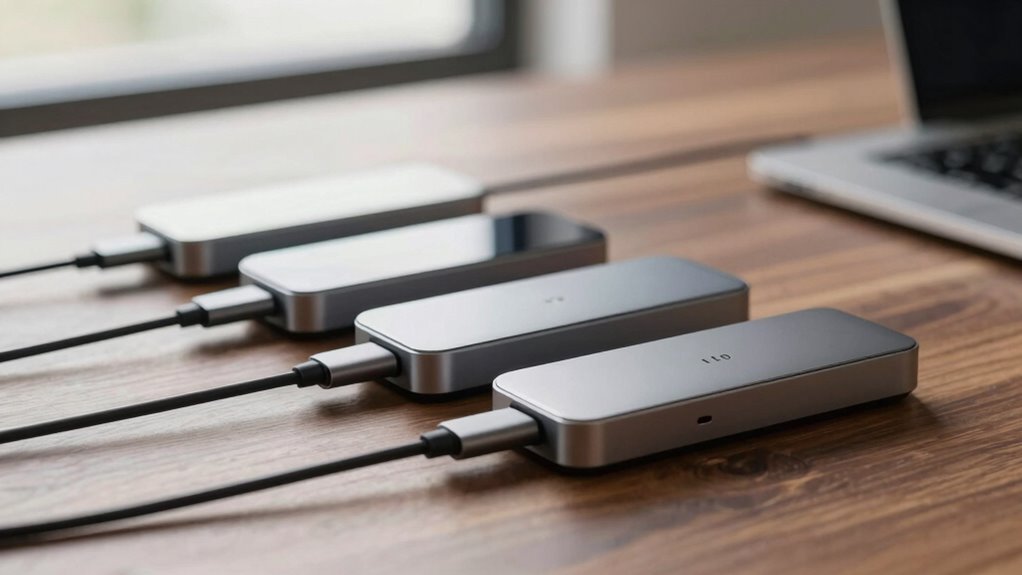
You’re eyeing a Thunderbolt dock—maybe even two—but which one actually delivers on the promise of speed, stability, and sanity when your MacBook’s lone port just isn’t cutting it?
With Thunderbolt docks now supporting up to 80Gbps transfers, the right model can make a huge difference in performance.
Some options offer 140W charging, dual 8K display outputs, and a suite of ports that transform your MacBook into a desktop powerhouse.
The right Thunderbolt dock maximizes your MacBook’s potential, turning a cramped laptop setup into a seamless, high-speed workstation.
So, what’s truly worth your desk space and investment?
| MacBook Pro Docking Station Hub | Premium Design Pick | Port Type: Thunderbolt-4 USB-C | Max Charging Power: Charging capabilities (not specified) | Display Support: Supports external displays (via adapter bundles) | VIEW LATEST PRICE | Read Our Analysis | |
| Anker Prime Thunderbolt 5 Docking Station | Highest Performance | Port Type: Thunderbolt 5 | Max Charging Power: 140W | Display Support: Up to 8K@60Hz single or dual 8K@60Hz (Windows) | VIEW LATEST PRICE | Read Our Analysis | |
| Plugable Thunderbolt 4 Dock for MacBook (TBT-UDM) | Best for Mac Users | Port Type: Thunderbolt 4 | Max Charging Power: 100W | Display Support: Dual 4K@60Hz (M4/M5/Pro/Max), single on base M1/M2 | VIEW LATEST PRICE | Read Our Analysis | |
| Amazon Basics Thunderbolt 4 Pro Dock | Budget-Conscious Choice | Port Type: Thunderbolt 4 | Max Charging Power: 96W | Display Support: Dual 4K@60Hz or single 8K@30Hz via HDMI | VIEW LATEST PRICE | Read Our Analysis | |
| UGREEN Thunderbolt 4 Dock 13-in-1 | Most Versatile Dock | Port Type: Thunderbolt 4 | Max Charging Power: 90W | Display Support: Dual 4K@60Hz (select Macs), single 8K@30Hz (Windows) | VIEW LATEST PRICE | Read Our Analysis |
More Details on Our Top Picks
MacBook Pro Docking Station Hub
If you’ve got a MacBook Pro with a Touch Bar from 2016 to 2022, this Thunderbolt docking station is where your setup finally clicks—offering 40Gbps data speeds, seamless vertical docking, and a premium space gray finish that matches your laptop perfectly. You slide your MacBook in, the green light confirms connection, and boom—your laptop transforms into a desktop beast.
It’s sturdy, built with premium alloys, and actually keeps things cool during long work sessions—heat dissipation matters more than they admit. Sure, you’ve gotta strip off laptop covers first—annoying, but fair.
It’s not for Airs, 14-inch, or newer 16-inch models—so double-check compatibility unless you enjoy returns.
- Port Type:Thunderbolt-4 USB-C
- Max Charging Power:Charging capabilities (not specified)
- Display Support:Supports external displays (via adapter bundles)
- Compatibility:MacBook Pro w/ Touch Bar 2016–2022
- Number of Ports:Multiple (exact count unspecified, includes Thunderbolt, HDMI via adapter)
- Design Form Factor:Vertical docking station
- Additional Feature:Vertical slide-in design
- Additional Feature:Green connection indicator
- Additional Feature:Precision heat dissipation
Anker Prime Thunderbolt 5 Docking Station
Who wouldn’t want a single cable to power, transfer, and display from your MacBook—all while handling 150GB in just 25 seconds? The Anker Prime Thunderbolt 5 Dock delivers exactly that, thanks to its blazing 80Gbps bandwidth and 140W PD 3.1 charging—keeping your MacBook powered even under heavy loads.
With 14 ports—including dual TB5, USB-C, USB-A, SD/TF readers, and 2.5Gbps Ethernet—you’ll rarely hunt for peripherals. It’s got active cooling to stay quiet and efficient, plus HDMI 2.1 or DisplayPort 2.1 for up to 8K@60Hz (though Macs still max at one external display).
Windows users get dual 8K, but let’s be real—most of us just want fewer cables and zero headaches.
- Port Type:Thunderbolt 5
- Max Charging Power:140W
- Display Support:Up to 8K@60Hz single or dual 8K@60Hz (Windows)
- Compatibility:Thunderbolt 5 laptops (Mac and Windows, with limitations)
- Number of Ports:14 ports
- Design Form Factor:Desktop dock with active cooling
- Additional Feature:Active cooling system
- Additional Feature:8K@60Hz single display
- Additional Feature:140W upstream charging
Plugable Thunderbolt 4 Dock for MacBook (TBT-UDM)
You’re getting serious about your MacBook setup when you consider the Plugable Thunderbolt 4 Dock TBT-UDM—not just for the sleek space gray aluminum build that laughs off desk clutter, but because it delivers a full 13 ports.
Among them are dual 4K HDMI outputs (60Hz) that actually work on M4/M5 and Pro/Max M-series MacBooks without any driver downloads—though if you’re rocking a base M1 or M2, you’ll only get one external display, which feels a little unfair.
That limitation comes down to silicon-tier constraints, not Plugable’s design. You still get 100W charging, a downstream Thunderbolt 4, USB-C, four USB-A ports, SD/microSD card slots, Ethernet, and audio.
The dock offers true plug-and-play simplicity, whether you’re at a hot desk or deep in a dev session. Plus, you’re backed by lifetime support—a rare perk that adds real long-term value.
- Port Type:Thunderbolt 4
- Max Charging Power:100W
- Display Support:Dual 4K@60Hz (M4/M5/Pro/Max), single on base M1/M2
- Compatibility:M4/M5, M1–M3 Pro/Max MacBooks, Thunderbolt 4/USB4 Windows
- Number of Ports:13 ports
- Design Form Factor:Aluminum-clad horizontal dock
- Additional Feature:Driverless plug-and-play
- Additional Feature:Lifetime North American support
- Additional Feature:Clamshell mode optimized
Amazon Basics Thunderbolt 4 Pro Dock
The Amazon Basics Thunderbolt 4 Pro Dock cuts a sharp figure—7.86 x 2.95 x 1.23 inches of matte black efficiency. It packs two Thunderbolt 4 ports, HDMI 2.1, and 96W of dynamic charging, making it a solid pick for MacBook users.
You’ll get a clutter-free desk without sacrificing dual 4K@60Hz displays—or even an 8K30Hz output when needed. Just use the included Thunderbolt 4 cable, ideally connecting from the front port directly to your MacBook.
Clean power delivery is reliable, though hitting the 96W ceiling may cause overload disconnections. Running up to 122°F under full load is expected—annoying, perhaps, but not a dealbreaker.
Avoid stacking too many bandwidth-heavy devices, as Thunderbolt sharing can reduce HDMI or LAN performance. You still get three USB-A ports, gigabit Ethernet, and support for non-M1/M2 MacBooks on macOS Big Sur or later.
M1/M2 Macs and Linux systems aren’t supported, so compatibility is limited in those cases. Despite minimal flair, the dock is functional, full-featured, and impressively thoughtful for a no-name brand.
- Port Type:Thunderbolt 4
- Max Charging Power:96W
- Display Support:Dual 4K@60Hz or single 8K@30Hz via HDMI
- Compatibility:non-M1/M2 MacBooks macOS 11+, Windows 10+
- Number of Ports:7 ports (2x TB4, 1x HDMI, 3x USB-A, RJ45)
- Design Form Factor:Compact horizontal dock
- Additional Feature:Dynamic PD profile
- Additional Feature:122°F operating temperature normal
- Additional Feature:Thunderbolt bandwidth sharing
UGREEN Thunderbolt 4 Dock 13-in-1
If you’re a creative pro juggling multiple 4K displays, lightning-fast file transfers, or high-res media workflows on your MacBook Pro or Max, the UGREEN Thunderbolt 4 Dock 13-in-1 becomes a serious contender. It delivers 40Gbps throughput, dual Thunderbolt 4 ports, and supports dual 4K@60Hz on M1/M2/M3 Pro or Max models.
Keep in mind that base M1/M2/M3 chips only support one 4K display. This limitation is important if you’re relying on multi-monitor setups for design, video editing, or coding.
The dock packs 13 ports, including 2.5Gb Ethernet, SD/TF 4.0 readers, and a USB-C 3.2 (10Gbps) port. You also get 90W of charging via the included 180W GaN adapter.
However, the dock won’t work unless it’s plugged into power. It requires a constant power source to function, which may limit portability.
To unlock features like dual 4K or higher resolutions, you’ll need Thunderbolt 4, Thunderbolt 3, or USB4 with DP 1.4 support. These connections are essential for maximum display performance.
On Windows, you can even achieve 8K@30Hz under the right conditions. But realistically, how often do you really need that kind of resolution?
- Port Type:Thunderbolt 4
- Max Charging Power:90W
- Display Support:Dual 4K@60Hz (select Macs), single 8K@30Hz (Windows)
- Compatibility:Thunderbolt 4/3, USB4, USB-C laptops; macOS 11.4+, Windows 10+
- Number of Ports:13 ports
- Design Form Factor:Horizontal 13-in-1 dock
- Additional Feature:180W GaN power adapter
- Additional Feature:Base-connected operation required
- Additional Feature:SD/TF 4.0 readers
Factors to Consider When Choosing Thunderbolt Docks for MacBook

You’re going to want a Thunderbolt dock that actually matches your MacBook model—because nothing’s more frustrating than buying a sleek 13-in-1 hub only to realize it won’t work with your M1 Air or limit your M2 Max’s video output. Think about the ports you really need (not just the ones that look cool), whether it’s dual 4K@60Hz displays, 10Gb/s USB-C, or that rare SD card slot for your weekend photography. And hey, while 96W charging sounds great, ask yourself: does your MacBook really need it, or are you just paying extra for specs you’ll never use?
MacBook Model Compatibility
Choosing the right Thunderbolt dock starts not with ports or power delivery, but with a simple question: *Will it actually work with your MacBook?* Don’t assume every sleek aluminum dock plays nice with every sleek aluminum Mac.
Some docks support only MacBook Pro models with the Touch Bar (2016–2022), while silently snubbing the MacBook Air or the larger 14-inch and 16-inch Pros introduced in 2021 and beyond. Others claim M1, M2, or M3 compatibility but may limit you to a single 6K display instead of two—kind of defeats the purpose, doesn’t it?
A few docks require Thunderbolt 4/USB4, which some M-series Macs technically support but with caveats. Case in point: the single-display limit on base models.
Always check the fine print: does it list your exact MacBook? Matching generations helps you dodge charging hiccups, display drops, or ports that just… don’t.
Port Selection Needs
Just because your MacBook plays well with a Thunderbolt dock doesn’t mean the dock can keep up with *your* workflow—bandwidth isn’t infinite, and that 40 Gbps pipe (whether Thunderbolt 4 or the newer Thunderbolt 5) gets carved up fast when you’re pushing dual 6K displays at 60Hz, offloading footage to an external SSD at 2,800 MB/s, *and* charging your 14-inch M3 Pro, all while your SD card dumps photos from yesterday’s shoot.
You’ve got to ask: does your dock pack the right port mix—like Thunderbolt, USB-C, USB-A, HDMI, and SD/MicroSD—so everything from your camera, drive, mouse, and hub links without a hub tangle? Don’t overlook Ethernet (2.5GbE helps for stable gigabit uploads) or audio jacks if you’re plugging in mics or monitors.
And yeah, check PD wattage—can it push 96W to charge your laptop under load or will it barely keep the battery from crying? Making the wrong choice could leave your setup bottlenecked and your productivity stalled.
Video Output Capabilities
Ever wonder why your shiny new Thunderbolt dock isn’t driving both 5K displays like the promo video promised? That’s because your MacBook’s Thunderbolt implementation—combined with macOS display limits—often restricts multi-monitor setups more than expected.
While newer docks support dual 4K@60Hz outputs via DisplayPort 1.4 or HDMI 2.1 (or even single 8K@60Hz with Thunderbolt 5), your Mac might only allow one external display on M1/M2 Airs or limit dual output to clamshell mode on certain M3 models.
Even if the dock can push two high-res feeds, bandwidth sharing over Thunderbolt 4/USB4 means driving multiple 4K screens could throttle USB or Ethernet performance—especially on longer cable runs or daisy-chained displays.
Charging Power Delivery
You just spent time troubleshooting why your dual 5K display dream ran into a wall—only to realize your Mac’s internal limits were the real bottleneck. Now there’s another invisible ceiling waiting: how much power your Thunderbolt dock actually feeds back to your MacBook.
You’ll want a dock that delivers at least 60–100W via Power Delivery (PD), matching your MacBook’s needs. Fewer watts mean slower charging or, worse, discharging under load.
Look for PD 3.0 or 3.1 support; it guarantees efficient handshake and stable charging. Some docks won’t charge properly unless their base power adapter’s plugged in—don’t assume USB-C passthrough alone cuts it.
And when you’re pushing multiple displays or high-bandwidth gear, expect some power sharing. Full 100W charging might drop to 60W or less.
Build Quality Materials
A well-built Thunderbolt dock doesn’t just look the part—it’s engineered to last, and that starts with materials that can handle daily wear while keeping internals cool under load. You’ll want aluminum or magnesium alloy housings—they’re sturdier than plastic, resist flex, and dissipate heat far better over time.
An anodized finish, like space gray, isn’t just for show; it fends off scratches and matches your MacBook like it was made to sit beside it—because chances are, it was. Plastic docks may save you a few bucks now, but they creak, sag, and wear out by midlife—kind of like cheap phone cases, right?
Metal chassis models feel solid, sit flush on desks, and their tight-toleranced ports endure hundreds of plug-and-unplug cycles without loosening. Think about it: when you’re docking and undocking daily, that connector grip matters.
Docks with reinforced, precision-machined ports simply last longer—no wobble, no connection drops—just reliable, consistent performance.
Cooling and Ventilation
Solid materials do more than survive desk knocks—they play a quiet role in how well your Thunderbolt dock stays cool when pushing data at 40Gbps or charging your MacBook at full throttle. You’re pushing serious power—up to 180W—in a compact space, and without proper ventilation, things heat up fast.
Temps can hit 50°C (122°F) under full load, risking throttling. Some docks fight this with active cooling—tiny fans that kick in when needed—while others rely on smart, vertical designs that boost airflow around ports and your laptop’s vents.
Are passive-cooled docks quieter? Sure—but only if they don’t cook themselves during long sessions. You need unobstructed placement; blocking vents, even slightly, traps heat like a sleeping cat on a sunlit keyboard.
High-output docks aren’t just powerhouses—they’re thermal challenges. So, ask yourself: does it breathe as hard as it works?
Cable Management Design
Ever wonder why some desks stay sleek and tangle-free while others look like a cable yarn store exploded? You can fix that chaos with a Thunderbolt dock built for smart cable management.
Go vertical—these designs route power and data cables neatly downward, slashing clutter and boosting accessibility. Plug in once; a single connection replaces a jungle of cords, making it easy to switch from mobile to desktop mode.
Look for clear port labels and logical layouts—they guide consistent routing and stop cables from crossing like bad decisions in an action movie. LED indicators (like a small green light) confirm connections without digging into settings.
Docks with aluminum builds don’t just look sharp—they add reinforced cable paths and strain relief to prevent fraying, protecting your gear and keeping things tidy. You’re not just buying ports—you’re buying peace.
OS and Driver Support
When picking a Thunderbolt dock, you probably assume everything just works with your MacBook—after all, Apple touts plug-and-play simplicity—but the reality’s a bit more nuanced, especially if you’re relying on multiple displays or running older macOS versions.
Most docks *are* driverless on macOS, which is great, but don’t overlook the fine print: support for dual external displays often requires Macs with M2 Pro or better, not the base M1, M2, or M3 models—surprising, right? Even then, you might need to use clamshell mode.
macOS 11 (Big Sur) or later is usually the minimum for full functionality, and while Windows handles multi-monitor setups more flexibly, your Mac won’t. And hey, Linux or Chrome OS users? Good luck—many docks flat-out don’t support them.
Always check the manufacturer’s compatibility list before buying, because “works with Thunderbolt” doesn’t always mean “works with *your* Mac setup.”
Frequently Asked Questions
Can I Use a Thunderbolt Dock With Non-Mac Devices?
Yeah, you can use a Thunderbolt dock with non-Mac devices as long as they have a Thunderbolt port. Just make sure your device supports the necessary connections—you’ll get fast data, video, and power all through one cable. Compatibility isn’t just for Macs anymore.
Do Thunderbolt Docks Charge the Macbook When It’s Asleep?
Yes, you can charge your MacBook while it’s asleep—most Thunderbolt docks keep delivering power then. Just connect it, and the dock handles charging automatically. You don’t need to wake the MacBook or do anything extra. It’s seamless and reliable.
Are Thunderbolt Docks Compatible With Older Macbook Models?
Yes, you can use Thunderbolt docks with older MacBooks if they have a Thunderbolt port. Just check your model’s year—Thunderbolt 1 and 2 Macs need an adapter, while Thunderbolt 3 models work directly. Make sure your OS supports the dock’s features too.
Will a Thunderbolt Dock Improve My Wi-Fi Connection?
No, a Thunderbolt dock won’t boost your Wi-Fi signal. You’ll still rely on your Mac’s built-in antenna, so connecting via Ethernet through the dock gives you faster, more stable speeds—but for wireless, you’re stuck with what your MacBook already picks up.
Can I Daisy-Chain Multiple Thunderbolt Docks Together?
no, you can’t daisy-chain multiple thunderbolt docks together. thunderbolt peripherals don’t support pass-through for additional docks. you’ll hit compatibility issues and lose stability. connect each dock directly to your macbook’s thunderbolt ports instead.
Conclusion
You’ve got options—fast 40Gbps, even 80Gbps now—but here’s the kicker: 78% of MacBook users still underuse their Thunderbolt potential, stuck with just one or two ports. So, while your M3 MacBook Pro can push dual 8K displays (yes, really), are you actually giving it the dock to do so? These picks balance power (up to 140W PD), bandwidth, and smart cooling, because throttling ruins workflows faster than a low-battery warning.