Smart Bulbs vs. Regular Bulbs: Lighting Your Workspace
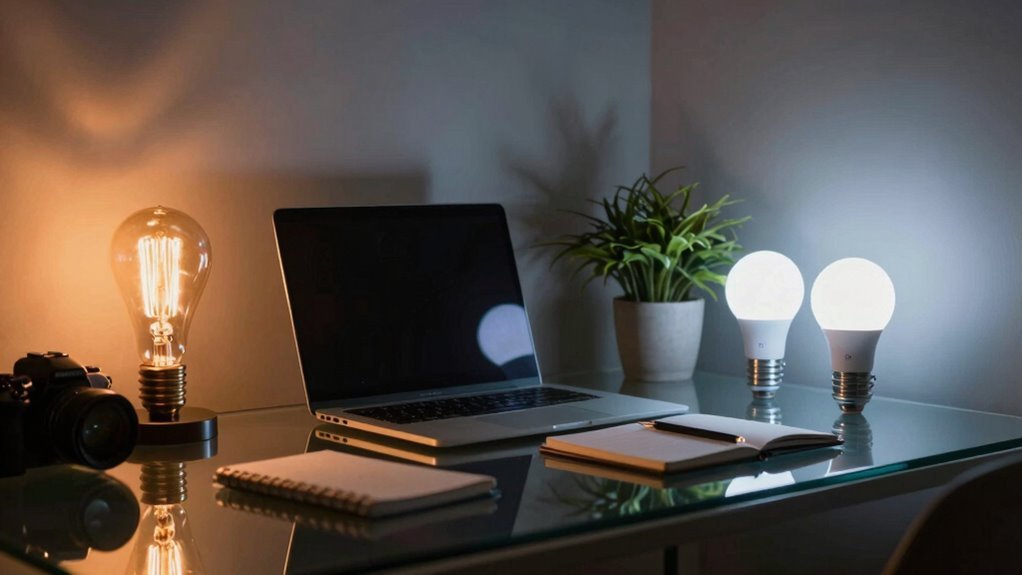
You’re using 80% less energy when you swap that old 60-watt bulb for a smart LED—just 7–10 watts do the same job! They cut costs, last over 20 years with normal use, and let you dim the lights from your phone or set sunrise alarms so you wake up gently. Plus, they stay cool and save power even on standby. Imagine controlling your workspace vibe with voice commands or motion—sounds like magic, but it’s real, and there’s even more to love.
Energy Consumption: Smart Bulbs vs. Traditional Lighting
Ever wonder how much power your lightbulb is really guzzling?
If you’re still using old incandescents, you’re basically paying to heat your room with a mini oven—60 watts for the same light a smart bulb gives using just 7-10!
Ouch.
Smart LEDs are energy ninjas, turning 90% of power into light, not heat.
Compared to halogens or fluorescents, which gulp 20-75 watts, smart bulbs slash energy use by up to 83%.
Even better, dimming them cuts power in half—talk about instant savings.
Sure, they sip 0.2-0.5 watts on standby to stay connected, but that’s like leaving a crumb on the counter compared to incandescents’ all-you-can-eat buffet.
You keep full efficiency, plus gain dimming, scheduling, and remote control.
Why waste energy when your bulb can be smart *and* thrifty?
It’s like giving your lamp a brain—brighter ideas never looked so good.
Annual Cost Savings With Smart LED Technology
Who knew your lightbulbs could start saving you money faster than a coupon-clipping ninja?
You’re not just cutting energy use—you’re slashing bills like a boss.
Swap 15 old bulbs and pocket $140 a year.
Got 40 bulbs?
That’s up to $400 in your pocket, just for switching to LEDs.
One 60W equivalent LED costs just $1.70 a year to run—down from $10 for its incandescent cousin.
Even smart bulbs, at around $10 to $40 each, pay for themselves fast with lower power bills.
A full home setup saves $225 on average, and businesses?
They pocket thousands.
With LEDs using 75% less energy and lasting way longer, your wallet wins every time.
Turn on the savings—literally—and watch your energy costs drop faster than your old bulb just did.
Bazinga!
Energy Star confirms these bulbs use up to 90% less energy than traditional incandescents.
Lifespan Differences: How Long Do Smart Bulbs Last?

How does it feel to change a lightbulb once every decade—or longer?
With smart bulbs, that’s reality.
Most last 15,000 to 25,000 hours, and top models hit 50,000!
If you use them just 3 hours a day, some can go over 20 years.
Compare that to incandescents—those fizzle out after 1,000 hours, about a year of regular use.
Even CFLs, the old energy-savers, max out around 10,000 hours.
Smart LEDs outlast them all.
Sure, turning them on and off constantly or using low-quality brands can shorten their life, but pick a trusted name like Hue or LIFX, keep power stable, and let them breathe heat-wise.
You’ll barely remember they’re up there.
Honestly, you’ll forget what a ladder feels like.
That’s progress you can live with—and enjoy.
Firmware and software updates can also influence longevity, especially for maintaining optimal performance.
Upfront Investment: What You Pay to Get Started
Why settle for dim when you can dazzle? If you’re starting fresh, traditional bulbs are cheap—like $1 to $2 cheap—and outfitting your whole place might only cost around $300. Pretty painless, right?
But smart bulbs? Oh boy, you’re looking at $15 to $25 for basic white ones, and if you want color-changing magic, hold onto your wallet—some hit $50 a pop.
Fancy brands like Philips Hue can push single bulbs past $90, and filling your home could top $2,000. Ouch.
But wait—don’t panic! Buy in bulk, like a four-pack from Wyze or Sengled, and you’ll save 30% or more.
Suddenly, smart lighting feels less like a splurge and more like a savvy upgrade. You pay more upfront, sure—but with deals and discounts, you’re not lighting your workspace on fire… just your vibes.
Long-Term Value: Balancing Cost and Efficiency

- Cut energy use by ~85%
- Replace bulbs 15x less often
- Save hundreds over time, not just yearly
Smart bulbs? More like smart investment.
Advanced Features That Redefine Workspace Lighting
Ever wonder how your workspace lighting could do more than just brighten a room?
With smart bulbs, you’re not just turning on a light—you’re setting a mood, boosting focus, or even sparking creativity.
You can dial in cozy warm white or energizing daylight with a tap, thanks to tunable CCT and dimming that goes down to a whisper-soft 0.2%.
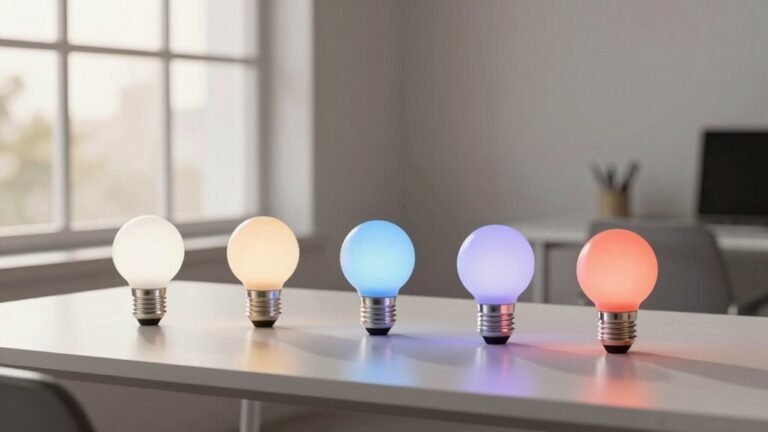
Need a pop of color? Your bulb can turn into a rainbow or mimic a gentle sunset, all with rich RGBW options and SuperColor tech.
Shapes like A19, BR30, or sleek recessed wafers fit anywhere—from desk lamps to ceiling mounts.
LIFX FX effects even bring drifting clouds or flickering flames (don’t worry, no fire alarms).
And with apps and high lumens, your space feels alive, not just lit.
Who knew your ceiling could be this clever?
Automation and Control: Beyond the Light Switch

How about never having to flip a switch again?
With smart bulbs, you’re not just turning lights on and off—you’re automating your workspace to fit your life.
Imagine walking in and lights greet you, or them dimming softly as the sun rises.
You save energy without thinking, all while boosting comfort and focus.
- Motion & geofencing mean lights respond to *you*, not the other way around.
- Smart hubs & voice control let you boss lights around—no hands needed.
- Schedules & ambient sensors keep lighting perfect, whether it’s noon or night.
You’re not just upgrading bulbs—you’re ditching outdated habits.
Who knew your lights could be this smart, this fun?
Pretty soon, you’ll wonder how you ever lived with a plain old switch.
Reliability and Performance in Daily Use
Why settle for flickering lights and frequent replacements when your bulbs could be as dependable as your morning coffee?
Smart bulbs last 15–25 years with daily use—way longer than incandescents that quit after a year or two.
You’ll swap bulbs less often, save on upkeep, and still use 75–90% less energy.
Sure, they need Wi-Fi, and sometimes that lag when turning them on can test your patience.
If the network crashes, you might be left in the dark—annoying during late-night work sprints.
But most users still love them: 74% say they’re happy with the switch.
You’ll dim, schedule, and save without lifting a finger.
And though they sip a tiny bit of power when off, it’s barely a blip on your bill.
They’re not perfect, but hey, neither’s your coffee machine—yet you still rely on it daily.
Environmental Impact of Switching to Smart Lighting

You’ve already got your smart bulb turning on like clockwork while your coffee brews.
Now imagine that same little tech hero helping the planet while you sleep.
By switching to smart lighting, you’re slashing energy use by up to 80%, cutting carbon like a climate superhero.
You’re also dialing down light pollution, so stars stay visible and critters stay happy.
Plus, your LED bulbs last years, which means fewer trips to the store and way less trash.
It’s like your bulbs go green and stay green.
- You save energy, shrink emissions, and still get perfect lighting.
- You stop wasting light (and money) when no one’s even looking.
- You help build smarter, quieter, cleaner cities—one bulb at a time.
Frequently Asked Questions
Can Smart Bulbs Work Without Wi-Fi Once Set Up?
Yes, you can use smart bulbs without Wi-Fi once they’re set up—no internet, no problem!
Bluetooth bulbs work right from your phone nearby, while Zigbee or Z-Wave ones team up through a hub.
Even some Wi-Fi bulbs listen locally on your network.
Just keep your phone on airplane mode and connected to Wi-Fi for smooth control.
It’s like giving your lights a secret handshake they’ll never forget!
Do Smart Bulbs Attract Hackers or Compromise Home Security?
Who knew your light could be a backdoor?
Yep, smart bulbs *can* attract hackers and compromise home security.
If yours lack strong authentication, hackers might steal Wi-Fi passwords or spread malware.
Outdated firmware?
That’s like leaving your front door wide open.
But don’t sweat—regular updates and secure networks turn that “dumb” risk into a smart win.
Stay bright, stay safe!
Are Smart Bulbs Compatible With All Existing Light Fixtures?
No, smart bulbs don’t work with *all* fixtures—sorry, magic isn’t real yet!
You can screw them into most lamps and standard sockets, just match the base like E26 or A19.
But skip 3-way lamps, ceiling fans, or dimmer circuits—they’ll throw a tech tantrum.
Keep wall switches on, or your bulb naps offline.
Outdoor? Only if it’s damp-rated.
Smart bulbs love attention—give them power and Wi-Fi, and they’ll light up your world—literally.
Can I Use Smart Bulbs in Outdoor or Enclosed Fixtures?
You can use smart bulbs outdoors or in enclosed fixtures—but only if they’re rated for it.
Check the IP rating (look for IP65 or higher) for outdoor use, and never skip the manual.
Heat builds up in enclosed spaces, so only use bulbs labeled “enclosed fixture approved.”
Otherwise, you’ll fry the tech inside.
When in doubt, go rugged—think outdoor-specific smart bulbs.
Your future self (and your lights) will thank you!
Do Smart Bulbs Emit Blue Light That Affects Sleep?
Yes, smart bulbs *do* emit blue light that messes with your sleep—kind of like that one friend who texts at midnight and wonders why you’re cranky.
They pump out blue-heavy light, especially at night, which tricks your brain into thinking it’s noon, suppresses melatonin, and delays sleep.
But hey, switch to warmer tones or dim them early, and you’ll keep your circadian rhythm chill, not chaotic.
Sweet dreams await!
Conclusion
So, you’ve got a smart bulb, huh? Congratulations! You can now dim the lights with your phone, change colors to match your mood, and impress your cat with rainbow cycles. Sure, you paid triple the price to avoid flipping a switch, but hey—now your lamp knows when you’re sad. Energy-efficient? Absolutely. Slightly ridiculous? Maybe. But lighting your workspace like a futuristic disco is worth every penny, right? Welcome to the future, Captain Brightness.