Small Office Storage Hacks to Maximize Space
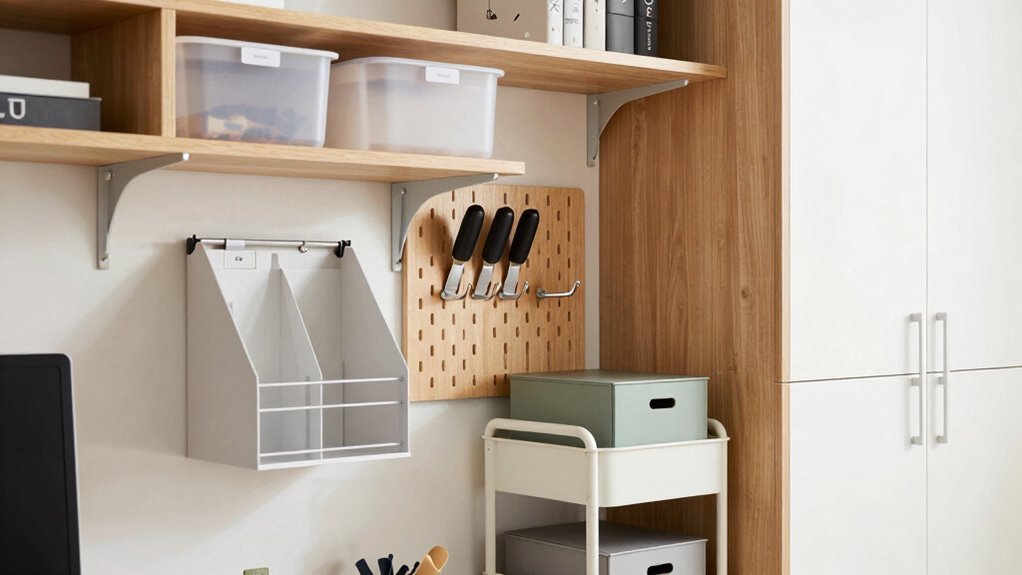
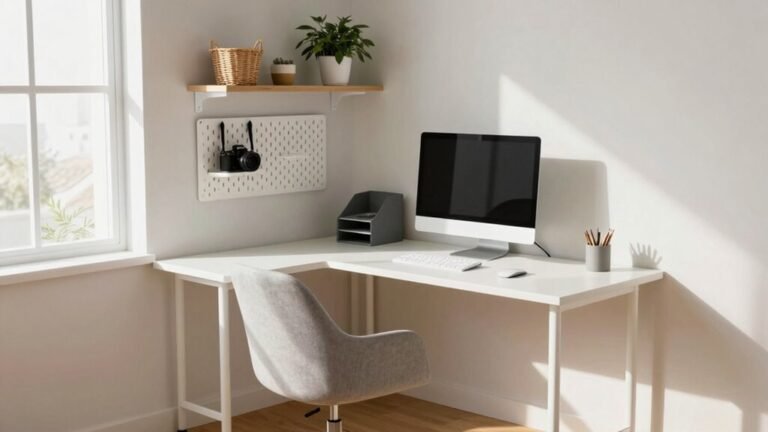
You’ve got walls, so go vertical with adjustable shelves and slatwalls to free up floor space. Tuck supplies at eye level, stash overflow higher up, and hang lightweight gear from the ceiling—yes, even your holiday lights get a home. Grab multi-functional furniture like storage ottomans or desks with secret compartments. Use labeled bins, fold-down desks, and slide bins under tables. Turn clutter into clarity with a smart system, and watch your tiny office work big. You’re just getting started…
Go Vertical: Maximize Wall and Ceiling Space
Ready to unlock hidden storage magic in your small office? You’ve got walls and ceilings begging to be used—stop letting them lounge around like lazy coworkers!
Mount adjustable shelves and stash supplies where it makes sense: eye-level for the staples you grab every day, higher up for that extra paper stash.
Use labeled bins so you’re not playing detective at 3 p.m.
Need more oomph? Go pro with steel shelves—they hold heavy boxes like a champ.
Hang lightweight stuff from the ceiling, like cables or seasonal decor, and free up desk real estate.
Think vertically, act boldly, and watch your floor space breathe again.
It’s like feng shui for productivity—minus the crystals.
Seriously, your walls aren’t just for art or sticky notes, they’re prime storage real estate!
With a little upward thinking, you’ll slash clutter and still have room for that celebratory happy dance.
Maximizing vertical space can boost storage capacity by up to 80%.
Choose Multi-Functional Furniture With Hidden Storage
You’ve already turned your walls and ceiling into storage superheroes, so why stop there?
Supercharge your small office by choosing multi-functional furniture with hidden storage—it’s like getting a closet that also works!
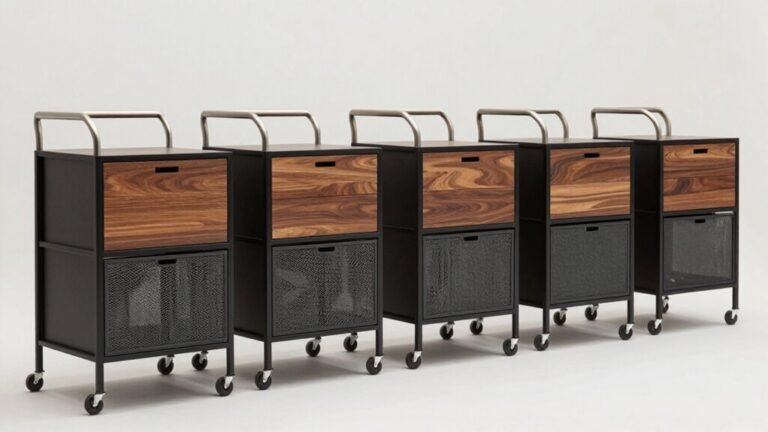
Pick a desk with sneaky drawers or a lift-top compartment to stash your laptop when not in use.
Wall-mounted hideaway desks save space and keep things tidy, while cabinet-style versions vanish into your decor.
Love to lounge? Try a storage ottoman—it’s a seat *and* a secret stash spot.
Some chairs even hide under-seat pockets for files or tablets.
Folding desks collapse flat, and modular units reconfigure as your needs change.
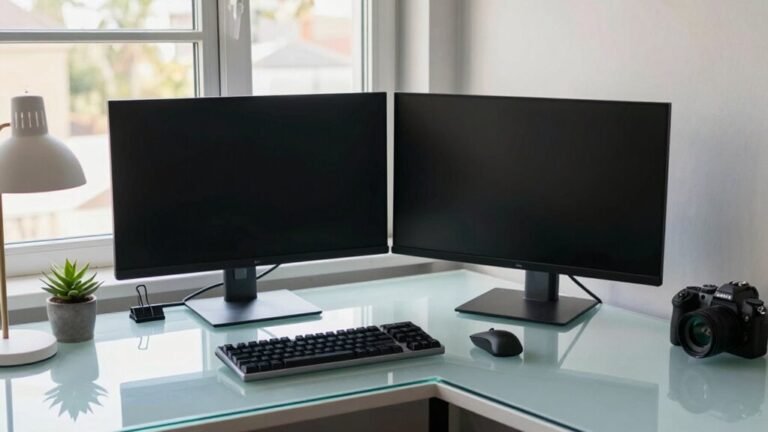
With cable management built in, everything stays neat and tangle-free.
You’ll laugh at how much you can hide in plain sight—furniture that pulls double duty? Now that’s smart (and a little sneaky).
Convertible designs let you switch between sitting and standing, supporting better posture with adjustable mechanisms.
Design Smart Work Zones for Faster Access

Imagine your office as a well-organized playlist—each zone hits the right note for the task at hand.
You’ve got your focus groove, your collaboration chorus, and your solo brainstorming verse.
Ditch the one-size-fits-all desk jungle.
Instead, create smart zones: quiet corners for deep work, lively hubs with whiteboards for team jams, and cozy phone booths for when you need to whisper secrets (or just take a call in peace).
Moveable furniture lets you rearrange the setlist on the fly—modular desks, rolling whiteboards, and reconfigurable walls keep things fresh.
Use rugs, lights, and seating to tell your team, “This is where the magic happens.”
Most workers dig open spaces but still want their personal pit stops.
Match the space to the task, not the job title, and watch time and effort melt away.
Who knew productivity could feel so groovy?
Activity-based working zones replace one-size-fits-all approaches, aligning with how people actually work—activity-based zones.
Optimize Containers for Smaller, Busier Spaces
When space is tight and your to-do list is long, every square foot has to work smarter, not harder—luckily, your storage containers don’t have to look like dungeon cells from a sci-fi flick.
You’ve got better options than stuffing junk into a metal box and hoping for the best. Make every inch count with these smart upgrades:
- Go modular—pick stackable or linked units with built-in climate control and security so your gear stays safe, cool, and easy to access.
- Fill vertically—use adjustable shelving, fold-down desks, and slatwalls to free up floor space and keep often-used items in sight.
- Standardize your bins—uniform totes and labeled rails mean no more digging for supplies, and everything fits like puzzle pieces.
Slim, smart containers keep your busy little office running smoothly—no tractor beams required.
Exploit Overlooked Areas Like Under-Desks and Above Doors

Where on earth can you squeeze in more storage when every inch is already spoken for?
Right under your nose—under desks and above doors!
Mount slim vertical organizers under your desktop to stash files and keep them handy but out of the way.
Slide in clamp-on drawers for pens, scissors, or keys, and free up precious drawer space.
Use fabric pouches or magnetic strips underneath for quick-access items—yes, even your stapler has a secret hideout!
Tuck power strips and charging docks beneath to banish cable chaos.
Then look up: above the door, floating shelves hold binders, bins, or even a stash of emergency coffee (we’ve all been there).
They’re out of the way but not out of reach.
With a little creativity, wasted spaces become storage goldmines.
Your office won’t just be tidier—it’ll feel bigger, smarter, and oddly satisfying!
Streamline Hybrids With Standardized, Scalable Solutions
- Use mobile shelving and multi-functional walls – they save space *and* double as quiet zones or display areas.
- Install tech-friendly lockers – size-flexible, secure, and perfect for laptops, gym gear, or that secret stash of chocolate.
- Match storage to actual usage – booking data shows Tuesdays are busy (52%), Fridays quiet (28%), so plan smart and avoid cluttered chaos.
Standardize now, scale later, and watch your small office breathe easy—like it’s finally found its happy place.
Declutter With a Systematic, Ongoing Plan

Ever wonder why your to-do list feels longer than a Monday morning meeting?
Blame clutter.
It eats up 4.3 hours of your week—gone, poof—searching for sticky notes, files, or that missing pen.
But here’s the fix: start with the 5S method—Sort, Set in order, Shine, Standardize, Sustain.
It’s not just fancy Japanese wisdom; it cuts job times, boosts focus, and slashes stress.
Unlike KonMari (sorry, no “joy” checks for staplers), 5S fits office life perfectly.
Imagine finding things fast, every time.
Employees in tidy spaces are up to 25% more productive and way less stressed.
Plus, clean desks mean happier coworkers and better retention.
Set small weekly goals, use the one-touch rule, and keep digital desks under 12 items.
Stick with it, and boom—clarity, calm, and way more done.
Frequently Asked Questions
How Do I Secure Tall Shelves to Prevent Tipping?
You secure tall shelves by anchoring them to wall studs with strong metal or nylon straps—never skip this!
Use at least two anchors, snug and sloped downward for max stability.
Screw into solid wood, not flimsy panels, and hit real studs, not drywall anchors.
Tighten fully—no wiggle room!
Bonus tip: stash heavy stuff low, keep toys off the top, and check anchors now and then.
Safety’s a breeze when you’re this smart!
Can I Mix Different Shelving Brands for Uniformity?
You *can* mix brands and still keep things looking sharp—I’ve seen it done!
Just stick to a consistent color scheme, repeat materials like wood or metal, and vary shapes for fun.
Think of it like an outfit: different pieces, same vibe.
Use uniform bins and labels to tie everything together.
Yep, it takes effort, but your shelves’ll look chic, not chaotic.
Win!
What’s the Weight Limit for Overhead Storage Cabinets?
You’re looking at 50 to 800 pounds, depending on the cabinet—seriously!
Wall-mounted ones usually hold 50–75 lbs, while heavy-duty overhead models can handle way more.
Check the specs, because that sleek box you love might tap out at 50 pounds.
Mount it right, use strong screws, and anchor into studs if you can.
You don’t want your storage dream crashing down—literally!
Play it smart, and you’re golden.
Are Stackable Bins Safe for Top-Heavy Items?
You bet they’re safe—for real, it’s like building a skyscraper with ninja-level balance!
Stackable bins handle top-heavy items no sweat, thanks to recessed lids, wide stacking ridges, and side ribs that lock things down.
Just center the weight, snap the lid tight, and you’re golden.
They won’t wobble, dance, or pull a Jenga move—promise.
Perfect for awkward, bulky stuff.
How Often Should I Replace Worn Storage Containers?
You should replace worn storage containers every few years, depending on the type and wear.
Plastic bins crack or warp, so swap them out every 3–10 years—sooner if they’re brittle or wobbly.
Metal containers rust or buckle, especially outdoors, so check for corrosion and replace them at 20–40 years, or earlier if they’re more cave than locker.
Fabric bins tear or stink, so retire them at 2–7 years.
Wood rots or sags—replace it when it looks more cottage-core than sturdy.
Inspect seals, hinges, and floors regularly; fix or replace anything that’s failing.
When repairs cost more than half a new unit, just swap it out.
Keep your space smart and safe!
Conclusion
You’ve got this! Turn unused nooks into goldmines—like Sarah in Austin who tucked rolling bins under her desk and freed up a whole square foot (hello, leg room!). Go vertical, grab multipurpose furniture, and laugh your way through clutter. Tiny tweaks? They add up. Before you know it, your cramped office feels like a spacious retreat—well, *almost* paradise. Just don’t hide your coffee stash too well!