LED vs. Fluorescent Office Lighting: A Comparison
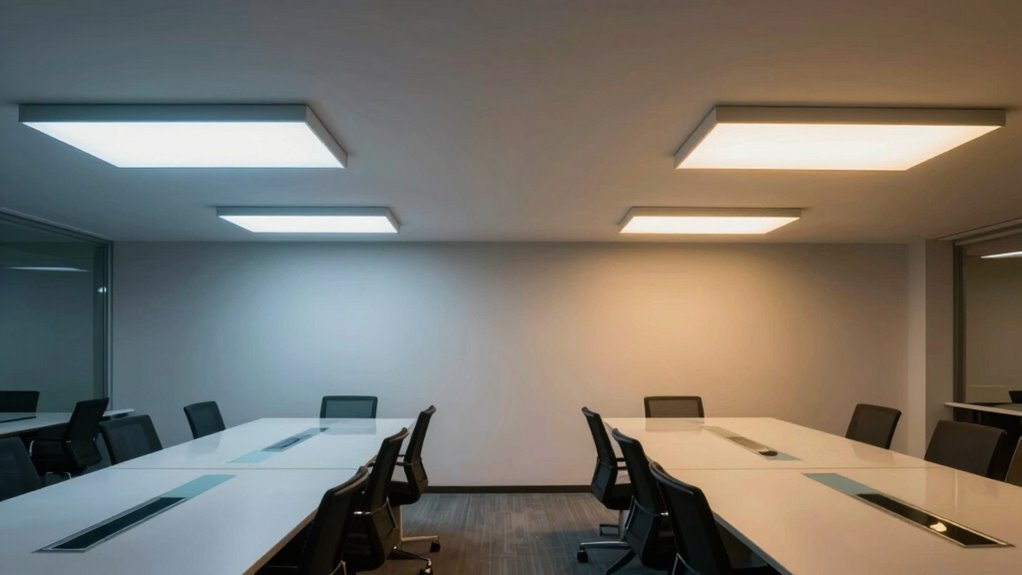
You’re cutting energy use nearly in half when you switch from fluorescent to LED office lighting—imagine saving 24 kWh a day with just 100 tubes. LEDs last years longer, stay bright, and won’t flicker like old fluorescents that buzz and give you headaches. They’re easier on the eyes, better for focus, and yes, even kinder to your wallet after the quick payback. Cool, steady light with no mercury surprises? That’s a win. Think it can’t get better—wait till you see what’s next.
Energy Efficiency Comparison
While you’re probably not losing sleep over your office lights, it’s worth staying awake for this: LEDs are seriously outshining fluorescents when it comes to energy efficiency.
You’re using up to 44% less power without sacrificing brightness—imagine running half the lights and still seeing everything clearly.
Swap a 32-watt fluorescent for a 15-watt LED, and boom, you’ve cut energy use nearly in half.
Your lights stay cool to the touch, too, since LEDs waste way less energy as heat—no more turning your office into a sauna.
The University of Michigan confirmed it, the U.S. Department of Energy backs it, and your wallet will love it: drop those kilowatts, slash cooling costs, and watch emissions plummet.
Switching all 100 tubes in your office? That’s 24 fewer kWh each day.
It’s not magic—it’s just smarter lighting.
Studies show LED systems are ~25% more efficient on average than fluorescent lighting.
Lifespan and Longevity
Ever wonder why your office is always changing light bulbs? With fluorescents, you’re not imagining things—they usually tap out after 6,000 to 15,000 hours. LEDs, though? They’re the marathon runners of lighting, often lasting 50,000 hours or more. Check this out:
| Feature | Fluorescent | LED |
|---|---|---|
| Rated Lifespan | 6k–15k hrs (up to35k) | 50k–100k+ hrs |
| End-of-Life | Sudden burnout or flicker | Gradual dimming (L70) |
| Failure Triggers | Ballast issues, cold starts | Overheating, driver flaws |
| Real-World Office Life | 3–5 years | 10+ years |
You’ll swap tubes way less often with LEDs, skip the ballast headaches, and enjoy steady light without the flicker. It’s like upgrading from a flip phone to a smartphone—once you go LED, you’ll laugh at how often you used to climb that wobbly ladder. This extended performance is due in part to 3–8x longer lifespan compared to fluorescent tubes.
Initial Investment and Operating Costs

You might wince at first when you see the price tag on LED fixtures—yep, they still cost more upfront than fluorescents, sometimes two to three times as much. But don’t sweat it—the gap’s shrinking fast thanks to smarter manufacturing.
Sure, a T8 LED bulb or fixture asks more at checkout, and the average LED bulb runs $2.50, pricier than its fluorescent cousin.
But here’s the twist: LEDs guzzle only half the energy—or less.
Swap a 32W fluorescent for a 15W LED, and watch your energy bill do a backflip.
You’ll save $418.68 a year on just 20 fixtures.
That kind of math means your payback time? Under six months.
Poof! That “expensive” LED just paid for itself.
So while fluorescents lure you with low first cost, they’ll nick you over time.
LEDs? They’re the gift that keeps on giving.
LEDs last over 25,000 hours, significantly reducing replacement frequency and maintenance costs.
Maintenance Frequency and Expenses
How often do you really want to climb a ladder just to change a lightbulb?
With fluorescents, you’ll be doing it every couple of years—sometimes more if the ballast fails or the office thermostat swings.
LEDs, though, last 25,000 to 50,000 hours, so you’re swapping bulbs way less often—maybe just once in decades.
That’s fewer late-night maintenance calls, less downtime, and no more stocking up on tubes like they’re going out of style.
You’ll save about $50 a year per fixture in labor and parts, especially since LEDs don’t need ballast replacements.
In high bays or tight spaces, that adds up fast.
Plus, no mercury means no special disposal dances.
Switching cuts maintenance trips by up to 75%, and most managers see the upgrade pay for itself in just a few years.
Less hassle, more shine—literally.
Light Quality and Color Accuracy

Swapping out flickering tubes less often is great, but when you actually look around your office, does everything appear dull, washed out, or just a little *off*?
With LEDs, you get truer colors because they’re designed to fill in the light spectrum evenly—no weird green or pink tints like old fluorescents love to throw around.
High-quality LEDs offer CRI 90+, meaning materials look natural, not like they’ve been edited with a bad filter.
Fluorescents? Often mid-70s CRI with spiky, uneven light that distorts reds and browns.
Plus, LEDs stay consistent over time, while fluorescents drift and mismatch like socks in a dryer.
- Trust what you see at a glance—no second-guessing color reports.
- Feel confident your space looks vibrant, not like a basement in 1998.
- Eliminate eye strain from unnatural light gaps.
- Impress clients with professional, true-to-life visuals.
Color Temperature Flexibility
While you mightn’t think a few hundred degrees on the Kelvin scale can make or break your workday, the right color temperature sets the whole mood of your office—like choosing between a cozy coffee shop and a crisp, alert workspace.
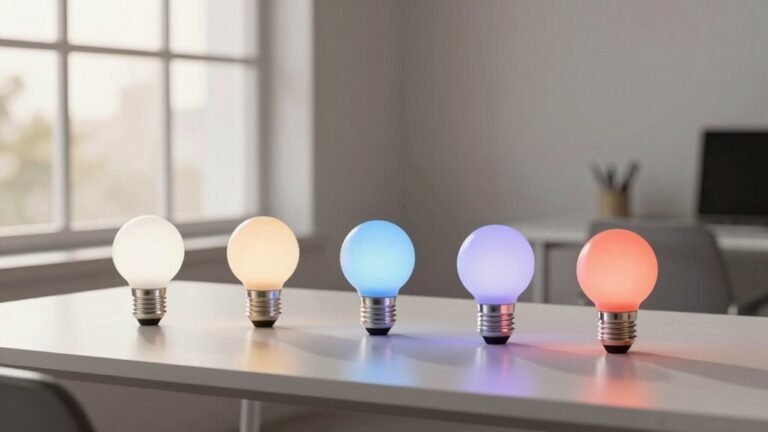
You’ve got options with LEDs, spanning from warm 2700K to bright 5000K, so you can match lighting to any zone.
Need 3000K for a relaxed break room? Done. Craving 4000K for focus? Easy. Even 5000K for screen-heavy areas? No problem.
Fluorescents, though, mostly stick to 3000K–4100K—like a one-note coworker who never changes. They can hit 5000K, but it’s rare and underwhelming.
LEDs let you mix and match, tailoring light like a pro DJ tunes a playlist.
With broader range and better flexibility, you’re not just lighting a room—you’re setting the vibe.
And honestly, who doesn’t love a little control (with a side of drama-free brightness)?
Performance in Cold Environments

You’ve picked the perfect color temperature to keep your office feeling fresh and focused, but what happens when the thermostat dips and your lights start acting like they need a morning coffee just to wake up?
Fluorescents lag, flicker, and dim in the cold—leaving you squinting and frustrated.
LEDs? They spring to life instantly, brighter and more reliable when it’s chilly.
No warm-up, no drama, just light.
- Feel confident your lights will work every single time
- Save time avoiding constant bulb changes
- Ditch the flicker that gives you a headache
- Trust your lighting in that drafty hallway or unheated storage room
With LEDs, cold isn’t a problem—it’s practically an advantage. You stay productive, comfortable, and yes, even cheerful, no matter the temperature.
Heat Output and Impact on Office Comfort
Ever wonder why your office feels like a sauna by noon, even when the AC’s running full blast?
Blame those old fluorescent lights—they’re pumping out way more heat than you realize.
Switch to LEDs, and you’ll cut that heat in half, thanks to their higher efficiency and lower wattage.
Less heat means your HVAC isn’t working overtime, slashing cooling costs by up to 40% in some cases.
LEDs also stay cool to the touch, making them safer and more comfortable, especially in open ceilings.
You’ll feel less warmth hovering over your desk, and your coworkers will stop sweating through meetings (literally).
With cooler fixtures and lower BTU output, lighting won’t wreck your comfort or your energy bill.
It’s like turning down the invisible oven fluorescents built into your office—simple, smart, and seriously revitalizing.
Flicker and Its Effects on Health

You mightn’t see it, but that subtle flicker in your office lights could be the reason your head’s pounding by 3 p.m.
Both fluorescent and LED lights can flicker—even if it’s too fast to notice.
Fluorescents with old ballasts buzz at 100–120 Hz, while cheap LEDs with bad drivers can pulse at risky low frequencies.
It’s not just annoying; it’s physical.
Your brain reacts, your eyes strain, and your mood sours without you realizing why.
Here’s how flicker messes with you:
- Gives you headaches that come out of nowhere
- Triggers migraines, especially if you’re already prone
- Makes your eyes feel dry, itchy, and exhausted by noon
- Leaves you feeling dizzy, nauseous, or just “off” by Friday
Funny thing? The lights look fine—until your body says otherwise
Impact on Employee Productivity and Well-Being
What if the secret to sharper focus and brighter moods at work wasn’t another cup of coffee, but the light above your desk?
With LEDs, you get daylight-like brightness (3500–6500K) that helps you see details clearly and stay alert.
Unlike flickering fluorescents, LEDs turn on instantly and stay steady, so your eyes don’t strain.
Their vibrant, consistent colors make design work easier and more accurate.
Plus, tunable LEDs can shift from energizing blue-rich light in the morning to calming warm light by evening, syncing with your body clock.
You’ll react faster, focus longer, and feel more awake—no caffeine crash needed.
LEDs also cut glare, run cooler, and rarely need replacing, so your workspace stays comfortable and quiet.
Less downtime, lower bills, and better light? Now that’s a bright idea.
Frequently Asked Questions
Can LED Lights Be Used Outdoors in Unheated Spaces?
Yes, you can absolutely use LED lights outdoors in unheated spaces—they’re built for that!
They’ll even shine brighter in the cold, unlike fussy fluorescents that struggle to start.
Just make sure the fixture’s got a solid IP rating, like IP65 or higher, so rain and snow stay out.
Check that the driver’s cold-rated too.
With the right pick, your lights will laugh at winter, last longer, and keep your space glowing bright without a drama—or a sweater.
Are Fluorescent Bulbs Recyclable, and How?
Yes, you can recycle fluorescent bulbs—they’re 100% recyclable!
Just don’t toss ‘em in the trash.
You’ll crush them in special drums, then sort the glass, metals, and that sneaky mercury.
Phosphor powder gets heated to zap out mercury, which gets purified and reused—talk about a comeback!
Store them safely, use mail-back kits or drop them at stores like Home Depot, and you’ll keep nasty stuff out of landfills.
Go team planet!
Do LEDS Work With Existing Fluorescent Ballasts?
Yes, some LEDs work with your existing fluorescent ballasts—no rewiring needed!
Plug-and-play models make switching easy, especially if you’ve got high-frequency ballasts.
Just swap the tubes and go.
But skip the old magnetic kind—they’ll just give you trouble.
Hybrid options are even smarter, letting you use the ballast now and bypass it later.
It’s like having your cake and eating it too, but with better lighting.
Win-win!
Can I Install LEDS in Old Fluorescent Fixtures?
You can totally install LEDs in your old fluorescent fixtures—yep, really!
Just pick the right type: go for plug-and-play Type A if you want it easy, or skip the ballast hassle with Type B’s direct wiring.
Worried about work?
Type C kits let non-electricians help out.
Swap out those old tubes, save energy, and brighten your space like magic—plus, no more flickering ghosts in the ceiling!
Do LED Lights Attract Fewer Insects Than Fluorescents?
Yeah, LED lights do attract fewer bugs than fluorescents—you’ll love that come evening.
Think of it as giving insects a polite “we’re closed” sign without turning off the lights.
Swap in warm-white LEDs, and you’re basically whispering, “Nothing to see here, folks,” to moths and gnats.
They’re less drawn to the warmer glow, so you get the brightness you need, minus the buzzing crowd.
It’s a win-win: clear space, clear mind, and way fewer midnight dances with fruit flies.
Conclusion
You’re swapping flickery tubes for sleek, steady LEDs, and honestly, it’s a no-brainer—like trading a crackling campfire for a space-age flashlight. They’re brighter, last longer, and won’t dim your mood (or your wallet). Plus, your eyes, your thermostat, and even your janitor will thank you. Flip the switch and let your office light up the future—no ghosts in the wiring, just pure, crisp glow. Game on!