Sustainable Home Office Practices for an Eco-Friendly Workspace
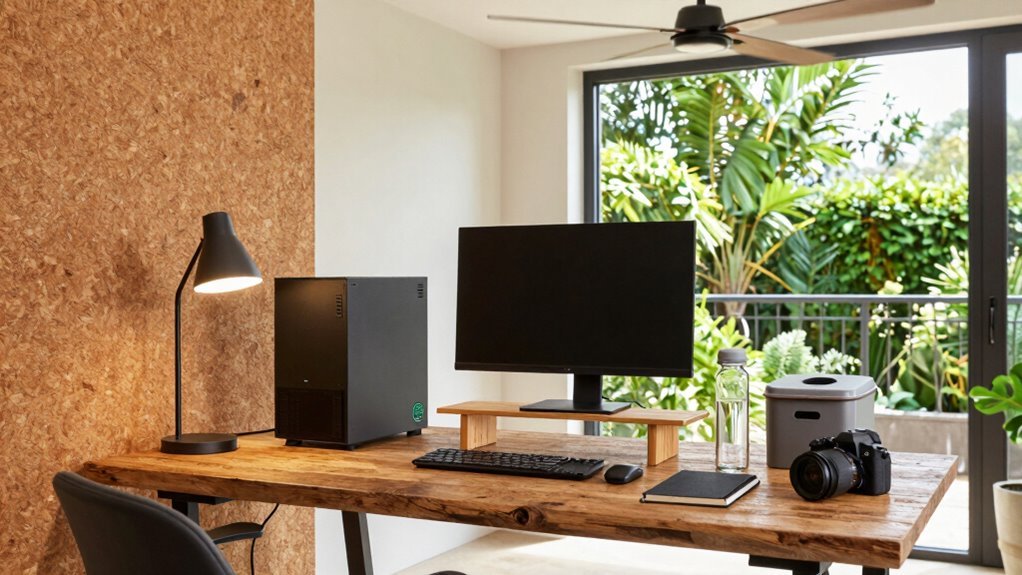
You can slash energy use by switching to LED bulbs and letting sunlight brighten your desk—nature’s free lamp! Work remotely to cut commute emissions, store files in the cloud, and skip the printer entirely. Furnish with reclaimed wood or recycled materials, and power up with solar energy when possible. Go hybrid to shrink your footprint without missing out on office vibes. There’s even more in store to make your workspace greener.
Reduce Energy Use With Smart Home Office Setup
Ever wonder how much energy your home office is actually sucking from the grid? You’re not just powering a laptop—you’re lighting rooms, charging gadgets, and maybe even heating spaces meant for the whole house.
But here’s the good news: small tweaks add up fast.
Swap old bulbs for LEDs—they use 75% less energy and last years longer.
Shine a desk lamp right where you need it instead of blazing overhead lights.
Crack open blinds and let sunshine do the work (nature’s free lightbulb!).
Add smart sensors to kill lights in empty rooms, and pick cozy, high-CRI LEDs that let you go bright *without* guzzling watts.
Your laptop? Make it an ENERGY STAR model, enable sleep mode, and watch it sip just a fraction of desktop-level power.
Plug devices into smart strips, see what’s hogging juice, and laugh as your savings stack up.
The average homeworking setup emits just 0.33378 kgCO2e per hour, making remote work a key player in cutting workplace carbon emissions.
Who knew being eco-friendly felt this smart—and looked this cool?
Cut Commute Emissions With Consistent Remote Work
Who would’ve thought skipping the daily grind—literally—could do so much good for the planet?
By working from home full time, you’re slashing your work carbon footprint by up to 58%.
Even one remote day a week cuts emissions by 2%, and going two to four days? That’s an 11–29% drop.
With 119 million U.S. commuters each burning 25.6 pounds of CO2 daily, every avoided drive adds up fast.
Remote work slashes transportation emissions—the dirtiest sector—by 10% if just 10% of us log on from our couches.
Sure, you might run a few extra errands, but hey, it’s not like your coffee run cancels out five saved commutes.
Cities breathe easier, traffic thins, and your car gets a well-deserved break.
Consistent remote work isn’t just comfy—it’s a climate win.
Who knew staying in could feel this heroic?
200 million tons of CO2 are saved annually in the U.S. thanks to reduced commuting from remote work.
Embrace Digital Tools to Minimize Paper Waste

You’ve already ditched the daily drive and shrunk your carbon footprint just by working from the couch—now let’s clean up another environmental habit: the paper pile-up.
Turn to digital tools and watch your printer gather dust—just like that old fax machine you refuse to admit you still own.
Go paperless with confidence by:
- Storing and sharing files in the cloud (Google Drive, Dropbox) so you’re not printing six versions of the same report.
- Ditching paper forms and using mobile apps for checklists and approvals—no more losing things in the couch cushions.
- Signing documents electronically instead of printing, signing, scanning, and pretending you didn’t spill coffee on page three.
You’ll save trees, reduce clutter, and finally win the battle against office supply creep.
Plus, your cat can’t shred your digital files—only your dignity.
Using digital collaboration platforms enables real-time editing and version control, eliminating redundant prints and ensuring everyone works from the latest version.
Design a Low-Waste Home Work Environment
Building a workspace that’s kind to the planet doesn’t mean sacrificing style or comfort—far from it.
Choose a desk made from reclaimed wood or modular furniture you can reconfigure later—bonus points if it’s chic.
Snap up upcycled textiles for chair cushions or curtains; they’re cheaper and keep junk out of landfills.
Toss plastic bottles? Not today—recycled plastics can become sleek wall panels that muffle noise and look snazzy.
Set up recycling bins for paper, plastic, and old gadgets, because 70% of office waste is recyclable (but often ends up sad and squished in a trash pile).
Start a mini compost bin—your houseplants will thank you with greener leaves and fewer attitude problems.
Zero-waste isn’t about perfection; it’s about smarter swaps, less junk, and loving your planet without losing your groove.
Power Your Workspace With Renewable Energy

How’s this for a power move—literally? You can run your home office on sunshine and wind, not just grid power.
Switching to renewable energy isn’t just for hippies and tech billionaires—it’s smart, it’s savings, and it’s simpler than you think. Whether you install panels on your roof or buy green energy from your utility, you’re cutting emissions and boosting energy independence.
- Go solar: A 6-kW rooftop system can slash your bill by 50–90%, especially with the 30% federal tax credit.
- Add wind if you’ve got space: With open land and steady breezes, small turbines pair well with solar for round-the-clock clean power.
- Choose green plans if you rent or can’t install: Many utilities offer renewable options so you’re powered by nature, not coal.
You’ve got options—pick your favorite flavor of sunshine.
Optimize a Hybrid Schedule for Maximum Impact
Ditch the suit (and the daily grind) without ditching your team.
You’re not stuck choosing between office buzz and home comfort—hybrid work’s your sweet spot.
Right now, 52% of remote-capable U.S. workers are splitting time just like you, averaging 3.74 days in the office.
Most go in 3 or 4 days, and with flexible models (like choosing your own days), 58% of companies back your freedom.
You save nearly 50 minutes a day in commute time—hello, extra coffee or walk!
Fewer trips mean lower emissions, and 59% of you even squeeze in dentist visits without extra travel.
Better yet, 69% of managers say teams are *more* productive.
Yes, you!
Outcome-based roles help you shine no matter where you log in.
Flextime? Role-based? Try what fits.
Just keep it light, keep it smart, and let sustainability work as hard as you do—minus the commute.
Frequently Asked Questions
How Do Time Zones Affect Remote Work Sustainability?
You’re juggling time zones, and yeah, it’s a puzzle—each hour apart cuts real-time chat by 11%, so you’re stuck waiting for replies, slowing progress.
You’re hopping on calls at odd hours, which can zap your energy and sleep.
Sure, fewer commutes slash emissions, but cranking the heat or AC in your home office ups your bill—and your carbon footprint.
It’s like a work-life seesaw you’re constantly trying to balance!
Can Remote Work Increase Household Energy Inequality?
Yeah, remote work can totally spike household energy inequality—imagine heating your whole house just for one Zoom call while your landlord sips piña coladas. You’re stuck with higher bills, outdated wiring, and zero control over upgrades.
Meanwhile, wealthier folks work cozy on efficient gadgets, sipping solar-powered lattes. It’s like everyone’s racing uphill, but you’re carrying extra bricks. Not fair, right? Let’s fix that imbalance.
Does Screen Size Impact Environmental Footprint at Home?
Yeah, screen size does affect your environmental footprint at home.
Bigger screens use more energy and materials, sure, but don’t panic—your 32-inch beauty might still beat two smaller ones in emissions.
Go for energy-efficient models with bright certifications, not just big egos.
Turn down brightness, enable auto-sleep, and voilà—you’re saving power without shrinking your workspace dreams!
Are Second-Hand Electronics Truly More Sustainable for Home Offices?
Yes, snagging second-hand electronics truly cuts waste—one person’s upgrade is another’s treasure!
Imagine this: 74 devices already sit, on average, in homes, waiting for a rebooted life.
You’re dodging mining emissions, slashing CO2, and skipping landfills—all while scoring cool tech.
Sure, some gadgets won’t last forever, but hey, giving electronics a second act isn’t just smart, it’s superhero-level planet-saving.
How Does Remote Work Influence Urban Tree Canopy Preservation?
You’re helping save city trees just by working from home!
With fewer commuters, cities are ditching car-centric expansions and turning empty lots into green pockets full of trees.
You’re also driving demand for yard trees in suburbs, though it’s a mixed bag—more trees at home, but sometimes at the cost of urban forest patches.
Smart planning turns your remote setup into a win for urban canopies, one leafy block at a time. 🌳😄
Conclusion
You’re slashing carbon like a superhero—did you know remote work can cut emissions by up to 54 million tons a year? That’s like taking 10 million cars off the road! Swap that commute for comfy slippers, go paperless, unplug when done, and maybe let your laptop run on sunshine. Small tweaks? Huge wins. You’re not just working from home—you’re helping the planet breathe easier, one eco-smart choice at a time. Awesome, right?