5 Best External Hard Drives for Reliable, Long-Term Backup
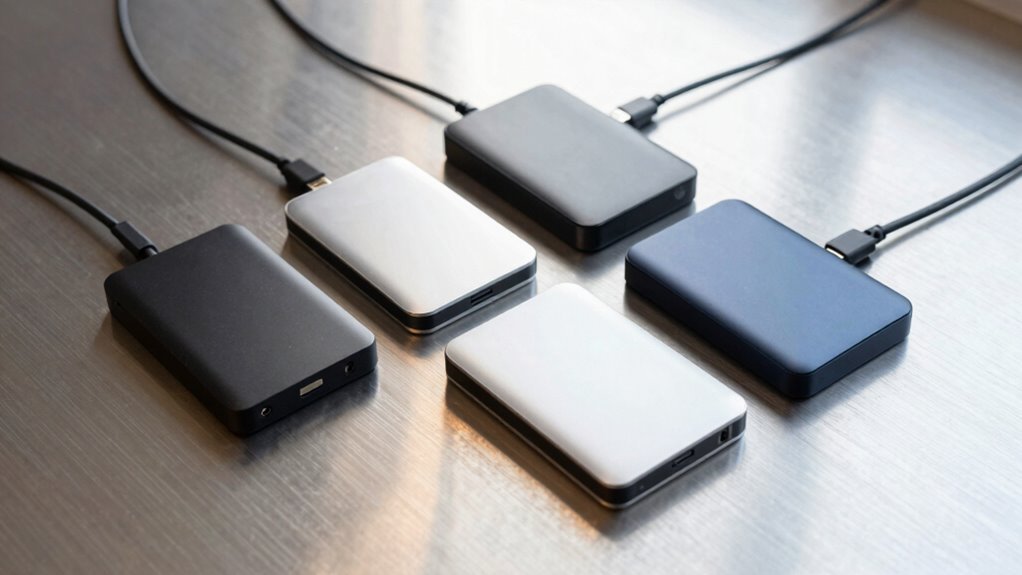
When it comes to reliable, long-term backup, you need an external hard drive that won’t fail after just two years.
The best external hard drives offer durability, fast transfer speeds, and secure storage for everything from 4K footage to critical financial records.
Opting for a no-name drive might save money upfront, but risks data loss from drops or hardware failure.
Look for models with rugged builds, hardware encryption, and speeds up to 1,050MB/s to ensure your backup stays safe and accessible.
Not all drives deliver on their promises, so choosing one proven in real-world use is essential—without breaking the bank.
| Crucial X10 Pro 1TB Portable SSD | Professional Grade | Storage Capacity: 1TB | Drive Type: SSD | Interface: USB-C, USB-A | VIEW LATEST PRICE | Read Our Analysis | |
| Seagate One Touch 2TB Portable Drive | Best for Creatives | Storage Capacity: 2TB | Drive Type: HDD | Interface: USB 3.0 | VIEW LATEST PRICE | Read Our Analysis | |
| Seagate Portable 2TB External Hard Drive | Reliable Everyday Backup | Storage Capacity: 2TB | Drive Type: HDD | Interface: USB 3.0 | VIEW LATEST PRICE | Read Our Analysis | |
| Seagate 5TB Portable HDD Black | Highest Capacity Pick | Storage Capacity: 5TB | Drive Type: HDD | Interface: USB 3.0 | VIEW LATEST PRICE | Read Our Analysis | |
| WD 2TB Portable External Hard Drive | Best Value | Storage Capacity: 2TB | Drive Type: HDD | Interface: USB 3.2 Gen 1 | VIEW LATEST PRICE | Read Our Analysis |
More Details on Our Top Picks
Crucial X10 Pro 1TB Portable SSD
If you’re the kind of creator who’s tired of waiting for files to transfer—yes, even with those “fast” external hard drives—the Essential X10 Pro 1 Gabís. You’re getting real speed here: up to 2100 MB/s read and 2000 MB/s write, which slashes export times for 4K or 8K footage (seriously, where was this during your last edit?).
It’s rugged too—IP55 rated, dust-resistant, and survives drops up to 7.5 feet. You can toss it in a bag without sweating, though you’ll still want to use the password protection (because, hello, 1TB of raw project files).
It works across Windows, Mac, iPad Pro, even gaming consoles—no dongle drama, thanks to USB-C and USB-A compatibility. You also get Acronis True Image and three months of Mylio Photos, which helps—if you remember to back up locally and in the cloud (you do, right?).
- Storage Capacity:1TB
- Drive Type:SSD
- Interface:USB-C, USB-A
- Compatibility:Windows, Mac, iPad Pro, Chromebooks, Android, Linux, PS4, PS5, Xbox
- Power Source:Bus-powered (via USB)
- Backup Method:Drag-and-drop, password-protected
- Additional Feature:Up to 2100 MB/s read
- Additional Feature:IP55 water, dust resistant
- Additional Feature:SSD password protection
Seagate One Touch 2TB Portable Drive
You’ll likely find the Seagate One Touch 2TB Portable Drive a smart fit if you’re a student, creative professional, or remote worker juggling large files across Windows, Mac, or Chromebook systems. It offers 2TB of storage in a compact 4.5 x 3.2 x 0.5-inch enclosure, making it easy to carry.
It features password-protected hardware encryption and a sleek brushed metal chassis for durability and security. You’ll connect via USB 3.0 for fast backups, and the drive is bus-powered—no external power needed.
With one click—or on a scheduled daily, weekly, or monthly basis—it handles your backups automatically. The included USB-A cable works out of the box, but users with USB-C laptops will need to buy an adapter separately, which can be inconvenient.
You also get a year of Mylio Create and a 4-month Adobe Photography trial (with redemption within one year), adding extra value. While the drive isn’t the fastest on the market, it delivers reliable, secure, and seamless performance.
Reformatting may be necessary to use it with Mac Time Machine, so keep that in mind. It comes with a standard limited warranty and includes Rescue Data Recovery Services for added peace of mind should data loss occur.
- Storage Capacity:2TB
- Drive Type:HDD
- Interface:USB 3.0
- Compatibility:Windows, Mac, Chromebook
- Power Source:Bus-powered (via USB)
- Backup Method:One-click or scheduled backup
- Additional Feature:Password hardware encryption
- Additional Feature:One-touch backup
- Additional Feature:3-month Mylio & 4-month Adobe CC
Seagate Portable 2TB External Hard Drive
The Seagate Portable 2TB External Hard Drive stands out as a reliable go-to for students, freelancers, or casual gamers who need compact backup without wrestling with complicated setups. This sleek 2TB drive fits in your pocket (just 4.5 x 3.2 x 0.5 inches), connects instantly via USB 3.0 (cable included), and works straight out of the box.
It works seamlessly on Windows, Mac, PlayStation, or Xbox, with no formatting or drivers needed. You’ll drag and drop files with ease, appreciating the plug-and-play simplicity.
Don’t expect blazing speeds—this isn’t the drive for heavy 4K editing, but do you really need that? With automatic recognition and a built-in 1-year Rescue Service, it’s practical, portable, and ready when you are.
- Storage Capacity:2TB
- Drive Type:HDD
- Interface:USB 3.0
- Compatibility:PC, Mac, PlayStation, Xbox
- Power Source:Bus-powered (via USB)
- Backup Method:Drag-and-drop backup
- Additional Feature:Drag-and-drop backup
- Additional Feature:No software required
- Additional Feature:1-Year Rescue Service
Seagate 5TB Portable HDD Black
Need space that keeps up with your ever-growing library of 4K videos, high-res photos, and game files? The Seagate 5TB Portable HDD Black has you covered—offering a generous 5TB, though actual usable space may vary slightly due to formatting.
You’ll appreciate its plug-and-play simplicity across PCs, Macs, PS4s, and Xbox consoles, plus drag-and-drop backups that feel effortless. It connects via USB 3.0 (a sturdy 18-inch cable’s included), fires up fast, and auto-recognizes—though you’ll need software for initial setup.
Sure, it’s not the sleekest drive out there, but it’s reliable, portable, and backed by a 1-year Rescue Service if things go sideways.
- Storage Capacity:5TB
- Drive Type:HDD
- Interface:USB 3.0
- Compatibility:PC, Mac, PS4, Xbox
- Power Source:Bus-powered (via USB)
- Backup Method:Drag-and-drop backup
- Additional Feature:5TB high capacity
- Additional Feature:Plug-and-play simplicity
- Additional Feature:Automatic recognition
WD 2TB Portable External Hard Drive
Looking for a no-fuss, plug-and-play storage solution that won’t hog your backpack space? The WD 2TB Portable External Hard Drive (WDBU6Y0020BBK-WESN) weighs just 4.6 ounces and slips in easily at 4.35 x 3.23 x 0.59 inches.
Compact and lightweight, it’s powered by a reliable 5400 RPM mechanical disk. You’ll get fast transfers over USB 3.2 Gen 1 (5 Gbps), and it works straight out of the box—no software needed.
It’s compatible with both Windows and Mac, though you may need to reformat for macOS. Bus-powered through a single USB port, it’s a no-brainer for travel.
With a 4.6-star average from nearly 300,000 reviews, this drive has earned real-world trust.
- Storage Capacity:2TB
- Drive Type:HDD
- Interface:USB 3.2 Gen 1
- Compatibility:PC, Mac
- Power Source:Bus-powered (no external power needed)
- Backup Method:Drag-and-drop backup
- Additional Feature:Bus-powered operation
- Additional Feature:Compact, lightweight design
- Additional Feature:4.6-star customer rating
Factors to Consider When Choosing External Hard Drives for Backup

You’ll want to size up storage capacity first—do you really need 5TB if you’re only backing up 2TB of photos and docs? Think about data transfer speed too, especially if you’re tired of waiting 20 minutes for 100GB to crawl over USB 2.0 (spoiler: that’s only 480 Mbps). And hey, what good is a speedy drive if it won’t play nice with your Mac, won’t survive a backpack tumble, or lacks basic encryption—because “oops” isn’t a backup strategy.
Storage Capacity
A ter coef might sound like overkill—until you’re juggling raw 4K footage, a decade’s worth of high-res family photos, and project files that creep past the 80% mark on a 1TB drive.
You’ve got options: 1TB, 2TB, or even 5TB units let you scale storage to match your actual needs—no guesswork. If you’re archiving 4K or 8K video libraries, or hoarding massive design projects, larger drives (2TB–5TB) aren’t just convenient; they’re practical, offering far more backup headroom.
Think ahead: that “just enough” 1TB drive today might leave you scrambling in six months. A 5TB model? It buys peace of mind—and room to grow—without constant upgrades.
And hey, don’t assume advertised capacity is what you’ll get; formatting and file systems eat into space, so double-check usable storage before buying. Plan smart, and you won’t outgrow your drive before your next birthday.
Data Transfer Speed
Picking the right storage capacity sets you up for long-term success. But none of it matters much if moving files feels like watching paint dry—so let’s talk speed.
You’ll want an SSD if you’re serious about quick backups: they routinely hit 1,000–2,100 MB/s reads and writes, blowing mechanical HDDs out of the water. Sure, that’s great on paper, but real-world performance depends on more than just the drive—it’s the whole chain.
Your USB interface, for instance, can be a bottleneck; USB 3.0 offers about 500–600 MB/s in practice, while newer USB-C and USB 3.2 Gen 2 drives push even higher. And don’t forget—cable quality, host port limits, or a fragmented HDD can drag speeds down fast.
Sequential transfers look impressive, but random access? That’s where SSDs really shine. So ask yourself: do you want to wait minutes—or hours?
Compatibility
What good is a lightning-fast 2,100 MB/s SSD if your laptop only has USB-A 2.0 ports? These ports bottleneck speeds to just 35–40 MB/s, making the drive’s full potential unusable.
You must match the drive’s interface—like USB-C, USB 3.2, or Thunderbolt—to your device’s available ports. Otherwise, you’ll need adapters, which can be unreliable or incompatible.
Most external drives work seamlessly with Windows and macOS right out of the box. However, Linux or Chrome OS users may face additional setup requirements.
If you’re backing up data from a PS5 or Xbox, check compatibility first. Some consoles require specific drive formats or particular power delivery standards.
Avoid drives that require bloated, proprietary software to function. Instead, choose plug-and-play USB mass storage devices for broader compatibility.
Reformatting may be necessary for uses like Time Machine or cross-platform sharing. Always verify formatting requirements before entrusting the drive with long-term data.
Build Durability
Even if your data survives a sudden downpour or a two-story tumble, your drive won’t unless it’s built to handle real-world hazards. Look for IP55-rated resistance to water and dust, which blocks low-pressure jets and limited particulates.
Models tested to survive drops from up to 7.5 feet (2 meters) offer added protection, since accidents happen whether you’re hiking with a field rig or just tripping over a power strip at home. Rugged portability features like reinforced corners or a lanyard loop won’t save your data directly, but they reduce the odds of a clumsy drop in the first place.
Build quality isn’t just about survival—it’s about consistency. You’ll notice high-performance models explicitly advertise shock, water, and dust ratings, while others rely on sleek enclosures that look tough but don’t guarantee protection.
Encryption Features
Security isn’t just about locking your drive—it’s about ensuring the lock holds even when the device falls into the wrong hands. You want hardware-based encryption, not software—it protects your data even if someone plugs the drive into a compromised computer.
Software encryption is better than nothing, sure—but it’s only as strong as the system it runs on. It relies on your laptop’s operating system, which can leave data vulnerable if the host machine is compromised.
When you set up your drive, you’ll probably need to create a password right away—don’t skip that step. Without it, the encryption is completely useless.
Look for drives that support cross-platform compatibility—Windows, macOS, and even Linux—without sacrificing encryption integrity. Universal access shouldn’t mean weaker security.
Is 256-bit AES standard? It should be. That level of encryption is widely trusted and expected for securing sensitive data.
Be honest—would you remember a complex passphrase if you wrote it down, or would you just stick it to your monitor? Balance security with usability, because a forgotten password locks you out just as effectively as a thief.
Plug-and-Play Simplicity
When you grab a new external hard drive, the last thing you want is a setup dance—thankfully, most modern drives deliver true plug-and-play simplicity, recognizing your computer the second you connect them and letting you start dragging files over like it’s 2005 all over again (in the best way). You’ll love how many drives work instantly—no drivers, no software, just fast USB 3.0 (or better) transfer rates the moment you plug in.
Drag-and-drop isn’t just easy—it’s universal, working across Windows, Mac, and even some gaming consoles without extra config. Sure, some drives *do* bundle backup tools (we’re looking at you, WD), but plenty run perfectly fine without installing a single byte.
Ever wonder why cross-platform formatting like exFAT matters? It’s because you shouldn’t need to reformat just to switch devices.
Plug in, copy over, unplug—done. Is that too simple? Maybe. But for reliable, no-fuss backups, simplicity wins.
Frequently Asked Questions
How Long Do External Hard Drives Typically Last?
They usually last 3 to 5 years, but yours might go longer with light use and proper care. You should back up data regularly and avoid drops or extreme temperatures to help it last as long as possible.
Can I Leave My External Drive Plugged in All the Time?
Yeah, you can leave your external drive plugged in all the time, but it’ll wear out faster. Unplug it when not in use to reduce heat and power stress, boosting its lifespan. Don’t rely on just one backup—rotate drives for safety.
Are Portable SSDS More Reliable Than HDDS for Backup?
Yes, portable SSDs outshine HDDs like stars in a storm—silent, shockproof, and lightning-fast. You’ll trust them more for backups since they’ve no moving parts to fail. Just don’t skip regular copies—you still need layers of safety.
Do External Hard Drives Need to Be Encrypted for Safety?
Yes, you should encrypt your external hard drive to keep your data safe. If it’s lost or stolen, encryption guarantees no one can access your files without the password—you’re the only one who can decrypt it.
Can I Use the Same Drive for Backup and File Storage?
You can use the same drive for backup and file storage, but it’s risky—if the drive fails, you lose both. For example, Sarah lost family photos and work files when her dual-use drive crashed. Keep backups separate for safety.
Conclusion
You’ve got options—solid ones—especially when 78% of data loss stems from drive failure and portables now last 5–7 years on average. The essential X10 Pro’s drop-tested toughness and 2,000 MB/s speeds impress, while Seagate’s hardware encryption adds trust. Sure, HDDs are slower (100–150 MB/s), but with 5TB options, is that such a dealbreaker? These picks balance speed, security, and capacity—because who *really* wants to lose family photos, tax files, or that novel draft?